


Piedmont Club - March 2026
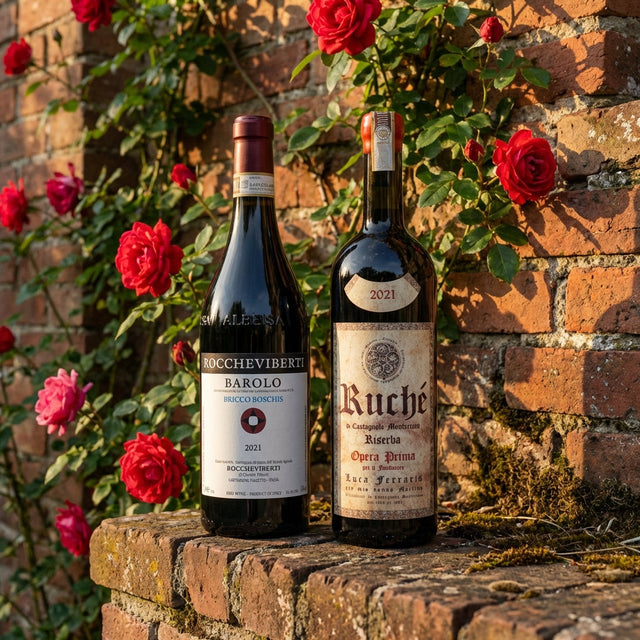
March is a good month for Piedmont because it’s not trying to be charming. It also comes after February and before April. These are wines that are built on specifics: small zones, precise vineyards, and winemaking choices that either respect structure or try to tame it. This month’s pair hits both sides of that coin: a flagship Ruché that’s intentionally made like a serious wine, and a traditionally raised Barolo from a top Castiglione Falletto MGA.
Ferraris Ruché di Castagnole Monferrato “Opera Prima” 2021
Ruché is a legitimately rare Piedmont red that only really exists at scale in and around Castagnole Monferrato, and the DOCG is small enough that producer identity matters as much as the place. Ferraris is one of the estates that pushed Ruché from curiosity into a wine that collectors actually cellar.
Opera Prima is their top bottling, sourced from the Bricco della Gioia site, with clay and tuff soils that help give the wine more depth than the lighter, early-drinking versions of Ruché. The élevage is the entire point here: long maceration and fermentation, malolactic in stainless, then 30 months in 500L French oak tonneaux and a full year in bottle before release. At 16.5% ABV, this is clearly made from fully ripe fruit and built to hold together with time, not just to smell pretty for five minutes. Open it now and it benefits from a real decant; or treat it like a serious northern Italian red and give it a few years to settle.
Roccheviberti Barolo Bricco Boschis 2021
Castiglione Falletto is one of the most “central” communes in Barolo, both on the map and in terms of style. It can give the perfume and definition people love in La Morra, but it usually comes with more grip and architecture without turning brutal on the tongue. That balance is why Castiglione so often feels like the cleanest “best of both worlds” answer when someone wants Barolo that’s expressive early but still ages like it should.
Bricco Boschis is one of the core names in the commune, and historically it’s been synonymous with Cavallotto. Here’s the part worth noting: Roccheviberti is the first producer to bottle a Barolo labeled from Bricco Boschis aside from Cavallotto, with their first vintage being 2014. Prior to that, the site had long been treated in the market as a single-producer story and quasi-monopole.
The winemaking is deliberately classic and keeps the focus on commune, site, and vintage: roughly three weeks of fermentation/maceration in stainless, malolactic in steel, then 24 months in large 25 hL French oak plus another year in bottle. Large-format oak is a choice, not a default: it’s slow oxygen exchange without new-oak flavor taking over, and it tends to preserve the linear, structural side of Barolo rather than sanding it down.
In 2021, that approach makes even more sense. This isn’t a wine designed to feel “ready” on arrival. If opening young, give it real air and put it with real food. If cellaring, this is exactly the combination of commune, vineyard name, and élevage that tends to pay you back later. This can outlast most humans if aged properly.
0 Comments
There are no comments for this article. Be the first one to leave a message!