

The 10 Crus of Beaujolais, Ranked
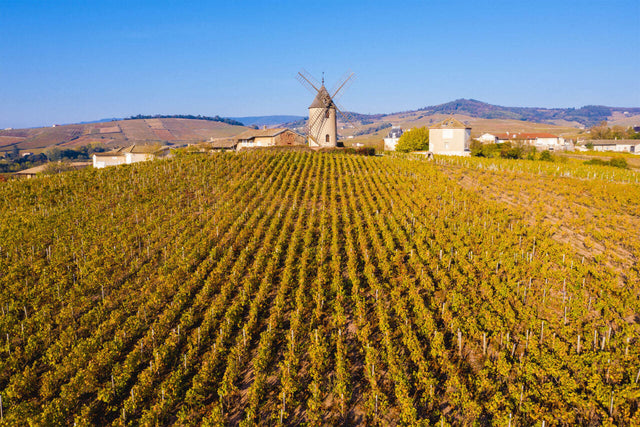
As do most wine nerds, we love Beaujolais, probably a little too much. Here's a completely unnecessary ranking of the ten crus. It must be noted that any cru Beaujolais can be an amazing wine, and no one ever regretted drinking too much cru Beaujo. Find all eleven recommended bottles for the sickest pairing party with hot dogs ever.
Honorable Mention: Lantignié
This is the "eleventh cru" and the one notable village which may have its name prominently displayed though it is not a cru in the proper sense. It borders Régnié, the newest official cru, to the east and sits relatively high up, providing lifted and fresh versions of Gamay that show enough complexity to warrant cru status. Yann Bertrand is a new-school natural producer whose name comes up a few times in this article, and for good reason. He produces wines of the highest quality from multiple spots around Beaujolais including here.
Recommended bottle: Yann Bertand Beaujolias-Villages Lantignié
10. Brouilly
Here's an odd case of a cru that completely surrounds another cru and is also totally overshadowed by it. Brouilly is the largest of the ten crus and lacks personality. Maybe it's the size that gets it due to lack of consistency. The soils promote mostly a bigger, bulkier style, and the hill in the center where the best soils are belong to Cote de Brouilly, a much more recognized cru for good reasons. I won't be mad drinking one, but it's rarely going to be my go to. Good examples, of course, still exist.
Recommended bottle: Alex Foillard Brouilly
9. Saint-Amour
This is the northern-most of the crus and juts right up against the southern part of the Macon and Pouilly-Fuissé. In fact, the soils can be more Macon limestone than Beaujolais granite, but there is a mix of both found here. No cru should be left behind, and this one just suffers from a lack of great examples more than anything else. The Bertrand example is natty new-school Beaujolais at it's finest and brightest; it lacks the haunting savory complexity in some of the other bottlings, but almost elevates Saint-Amour to a higher slot on its own.
Recommended bottle: Yann Bertrand Saint-Amour Les Bambins
8. Régnié
This is the youngest cru, and here, sandwiched between Morgon and Brouilly, we are in pure granite land. The cru was elevated in 1988, so not a lot changes legally in these parts. There's some pedigree of producers here and a handful of great bottles to choose from. It sits lower on this ranking due to the approachability and lack of serious-ness in most of the wines, but sometimes that elegance is also its strength. This is like having to choose which cat meme is the cutest.
Recommended bottle: Jean-Paul & Charly Thevenet Regnie Grain & Granit
7. Chiroubles
There exists a brain cell within me that could understand others ranking this high, cool cru as dead-last. But I've always just loved the vibrant, aromatic wines from this cru which in my book is the most underrated. At this point in the ranking the competition is getting steep, and there just aren't a ton of epic wines being made from this little spot, yet. It will always occupy a special place for me as a genuinely charming wine and area.
Recommended bottle: Steeve Charvet Chiroubles
6. Juliénas
This is a funny one. It definitely could have been lower, and initially was, but the more I considered it the more it raised. It lacks the grab-bag of famous old-school Beaujolais producers that grab the headlines like Foillard or Breton, but it does have great examples made by newer producer Yann Bertrand. There is also a solid foundation of great more Burgundy proper style wines with the structure to age. Domaine Cellier aux Moines' sister project in the cru probably elevates it one spot (see rec'd bottle).
Recommended bottle: Domaine Mont Bessay Julienas En Bessay
5. Chénas
Starting here we are getting into the ever-epic crus which could all make an argument for the top 3 spots, but for me the top three are etched in granite. Chénas is the smallest cru of the ten and at its best rivals the best of the best. The size might be holding it back as not many of the major major producers make wine from here either, but there's a bevy of overlooked, younger producers who make some major statements with age-worthy Gamay here.
Recommended bottle: Paul-Henri Thillardon Chenas Chassignol
4. Côte de Brouilly
Here we are, surrounded by the number 10 cru on this list but higher and more interesting, by a lot. The Côte surrounds the Mont Brouilly extinct volcano which lends it the unique blue stone soil called diorite. This same soil is found further at the top of this list, so keep an eye out. There's a serious structure and fleshiness to most wines from the Côte, and there's a bevy of great producers making it. Thivin takes the cake as the most representative of what this hill produces. If there were a gang of five, Thivin would be the fifth.
Recommended bottle: Chateau Thivin Côte de Brouilly
3. Moulin-à-Vent
In the classic textbook written by generations past this almost certainly would be number one. Perhaps it is still the most famous in the market globally, but the top two have jumped ahead with epic natural-tinged wines that there's no chance Moulin is getting promoted for now. The name literally means windmill, and though it's relatively low, it is windy. The style of the wines is big and cellar-worthy. Maybe the downfall is the large amount of more conventional styled wines than the avant-garde, edge of natty stuff that me and many wine nerds seek these days. Still, this is land where some of the world's best Gamay is grown and thou shalt respect it.
Recommended bottle: Yohan Lardy Moulin-a-Vent Vieilles Vignes de 1903
2. Fleurie
I have switched the top two in this ranking in my head about 593 times in the last hour. Fleurie is the best and my favorite cru, if anyone asks. The style is the wild side of Beaujolais and shows both indescribable aromatics with mid structure that can age but doesn't need to. Most of the most famous producers have a piece of land here and rarely do I prefer a different cru in a lineup. Why is it second? Beats me, but it's hard to argue against the top spot for Morgon.
Recommended bottle: Yvon Metras Fleurie (if you can find it)
1. Morgon
While I personally love the energy and sauvage quality of Fleurie, Morgon is no-doubt the cru where the largest number of collectible and epic Beaujolais wines come from. It could be argued that without Morgon we wouldn't have natural wine today, and we'd all be drinking a lot more chemically farmed garbage. Luckily, these four producers in the 1970's were never caught up in those spiderwebs and moved forward with wines they believed in. Without Foillard, Lapierre, Thevenet, and Breton it's unlikely I'd be writing or you'd be reading this article. Morgon rarely lets me or anyone else down and the best bottles of Gamay in the world are often found here, but sometimes in Fleurie. The best site, Cote de Py, also shares the volcanic origin soils with Cote de Brouilly. Fun Fact!
Recommended bottle: Jean Foillard Morgon Cote du Py
There you have it - track down all ten bottles for an epic showdown, but more realistically and importantly, realize that cru Beaujolais offers amazing drinking and the best pairing for hot dogs of all breeds.
0 Comments
There are no comments for this article. Be the first one to leave a message!