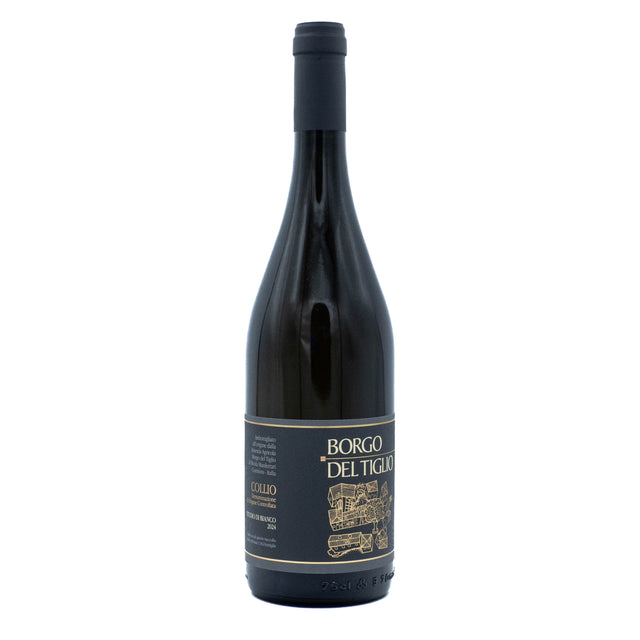
Borgo del Tiglio Sauvignon Blanc Etichetta Scura 2024
We have 3 in stock (Inventory is live and accurate)
Summer Shipping Advisory: Orders may be temporarily held during periods of extreme heat to ensure wine arrives in optimal condition.
View current shipping weather map →
The Land
Collio occupies the far northeastern corner of Italy, and the hills do not stop at the border: they run on into Slovenia as Brda, the same geology under a different flag. The Adriatic sits about 20 kilometers south, the first steep slopes of the Alps about 30 kilometers north, and the daily collision of cold dry mountain air with warm humid sea air is what holds acidity together at this latitude. Aspect settles the rest. Manferrari's position is that east-facing rows take the clean light of morning at lower temperatures, and that aromatic varieties belong there. He tore out his southwest-facing Sauvignon on that reasoning. The fruit here comes off the east and southeast flanks of the Ruttars hill, roughly 2.5 hectares of limestone-heavy ground he bought in 1989.
The Wine
One hundred percent Sauvignon Blanc, and not the Sauvignon most people picture. The Friulian strain carries small, straggly bunches of elongated berries and holds more acid than French clonal material, which allows a brief cold skin maceration without draining the wine of tension. After soft pressing, the must is deliberately left unprotected from oxygen ahead of fermentation, a choice aimed at aromatic durability decades out rather than impact on release. Fermentation runs in small, mostly used oak barrels, malolactic follows, and the wine spends nine to ten months in 250-liter casks. Etichetta Scura, the dark label, is the tier above the standard bottling: best barrels, best parcels, and only in years that justify it. White peach, ground ginger, lemon zest, sage. Salty and dense through the middle, near 15% alcohol carried without heat, a long finish that reads faintly sweet with no residual sugar behind it. Flint arrives with age.
The People
Nicola Manferrari took a pharmacy degree to keep his family happy and was working the counter at his mother's pharmacy in Gorizia when his father died in July 1981, leaving him under three hectares of vines. He is neither an enologist nor an agronomist. What he brought was chemistry, biology, and no formula. In 1982 he worked out the saignee technique from first principles, convinced he had invented it. He built the first double Guyot in Collio before learning that other regions had used it for years. Then he taught himself French over one Christmas from a neighbor's cassette course, for the single purpose of reading Francois Champagnol's physiology of the vine. Derive it, test it, then go check the literature: that habit is the method in this bottle.
Food Pairing
Manferrari points his Sauvignon at shellfish, and the wine agrees: whole roasted lobster with drawn butter, or crab cakes with lemon aioli, meet the salinity straight on. Tomato is less of a problem than people assume: a summer pasta with cherry tomatoes, torn basil, and good olive oil works because the acid in the glass matches the acid on the plate. Aged pecorino is the cheese, the salt in the rind answering the salt in the wine. This is the longest-lived white in the range, so buy two: open one with dinner this month and lose track of the other in the back of the closet for ten years.
We ship wine to most states with a $100 minimum order for shipping. We don't ship spirits nor beer.
Weather shipping advisory: Orders placed during times of extreme heat or extreme cold will be held for no charge until more favorable weather returns.
Sauvignon Blanc, a white grape of significant character, is believed to have originated in the Loire Valley of France, where it continues to produce some of the world’s most iconic and expressive examples. This variety has also found success in Bordeaux, where it is often blended with Sémillon, as well as in New Zealand, where it has become a signature grape, and many other regions across the globe. Known for its vibrant acidity and distinctive aromatic profile, Sauvignon Blanc often displays a pronounced greenness, with notes of fresh-cut grass, herbaceousness, and sometimes even a touch of jalapeño, depending on ripeness and region. These traits are often supported by citrus fruits like grapefruit and lime, leading to wines that are both refreshing and complex, ranging from steely and mineral-driven to more tropical and fruit-forward styles.