

Burgundy Club: May 2026
Greeting Burgundy lovers!
This month we are heading to two of my favorite corners of the Côte de Beaune: Pernand-Vergelesses for Chardonnay and Volnay for Pinot Noir. Neither village needs to scream to make the point. Pernand has the cold, limestone, tucked-behind-Corton thing going on, and Volnay remains one of the clearest examples of why Burgundy drinkers lose their minds over texture, perfume, and village identity.
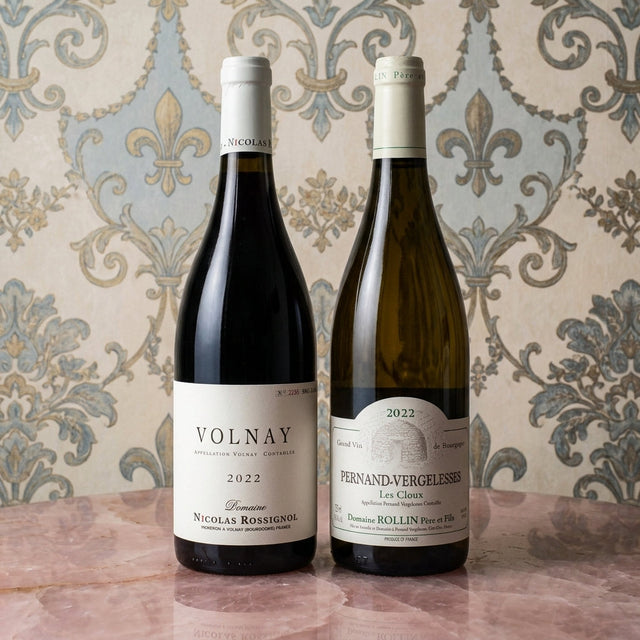
White: Domaine Rollin Pernand-Vergelesses Les Cloux 2022
Domaine Rollin is one of those producers that Burgundy nerds tend to know, but that has never really crossed over into hype territory. That is usually exactly where the value is. The family is based in Pernand-Vergelesses, the village wrapped around the back side of the Corton hill, and their wines tend to show the side of white Burgundy I like most: enough richness to feel complete, but with the limestone edge and freshness that keeps everything balanced.
Les Cloux is a village-level lieu-dit, but it behaves more seriously than that sounds. The site sits high on the slope, over 350 meters, facing southeast, in a sheltered pocket that gets ripe enough to give the wine some real texture. This is not thin, overly sharp Chardonnay. It has more volume than basic Pernand, but still shows the cool climate Chardonnay side of white Burgundy.
The winemaking is traditional but not heavy-handed. The grapes are mostly harvested by hand, pressed slowly, fermented naturally in oak barrels, with about 20% new oak, then aged on the lees for 10 to 12 months before bottling. In a warm but balanced vintage like 2022, that gives you a white Burgundy with ripe yellow fruit, citrus, a little hazelnut/oak framing, and acidity to match. This is a great bottle for roast chicken, scallops, prawns, richer fish dishes, or even blue cheese if you want to get a little weird with it.
Red: Domaine Nicolas Rossignol Volnay 2022
For the red, we are in Volnay with Nicolas Rossignol, one of the stronger modern names in the village. Nicolas is a fifth-generation Volnay grower who created his own estate in the late 1990s after working in Burgundy, Châteauneuf-du-Pape, Bordeaux, and South Africa. The domaine now farms across Volnay, Pommard, Beaune, Savigny, Aloxe, and Pernand, with no chemical herbicides and a vineyard approach influenced by biodynamics.
Volnay is often described as the elegant major red village of the Côte de Beaune. Compared with Pommard next door, Volnay generally gives less muscle and more fragrance, less square-jawed tannin and more silk. The best examples are not light wines exactly; they are detailed wines. Red fruit, flowers, spice, and fine tannin are the point.
This 2022 Volnay is a blend of several village-level plots, including Les Buttes, Les Grands Champs, Les Famines, and Les Lurets, with vines ranging roughly from 10 to 60 years old. The sites sit below premier cru vineyards like Clos des Angles and Chevret, on deeper chalky clay soils over limestone. With every vintage Nicolas seems to be delving more into the natural wine world, and the 2022 hits the balance point between natural and classic that I love. Minimal intervention enough to show clear sense of place but not so natty that it's cloudy pickle juice weirdness.
This is the bottle I would open with duck, roast mushrooms, pork tenderloin, chicken with herbs, or anything involving lentils and bacon. It is already very pretty, but it should also do well over the next five to eight years if you want to see the fruit settle into more spice and earth.
That’s all for this month — two classic Côte de Beaune villages, two very different expressions of Burgundy, and exactly the kind of wines that remind me why this region is still worth the trouble.
0 Comments
There are no comments for this article. Be the first one to leave a message!