


Burgundy Club: September 2026
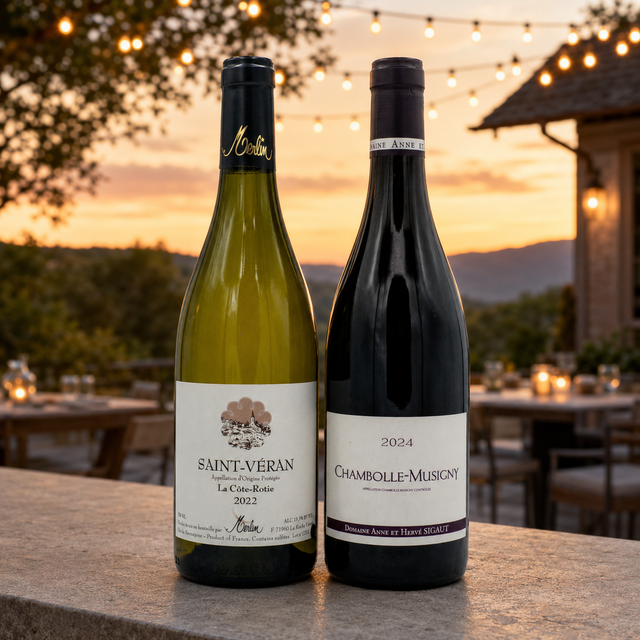
September is here, harvest is underway in France, actually pretty much done in Burgundy (!), and this club is a study in getting more than you paid for. The white comes from an appellation that keeps getting overlooked because its famous neighbor took all the attention, and the red comes from a vintage everyone spent two years worrying about that turned out to be exactly what Chambolle-Musigny does best.
White Wine: Domaine Olivier Merlin Saint-Véran "La Côte Rôtie" 2022
Let's get the obvious out of the way first: this is not Côte-Rôtie. Not the Syrah, not the northern Rhône, not Guigal. "Côte rôtie" simply means "roasted slope," and it's a name that shows up on steep, sun-facing hillsides all over France. This one is a lieu-dit in the Mâconnais and the wine in the bottle is Chardonnay.
Olivier Merlin started his domaine at La Roche Vineuse in 1987 and spent the following decades making the case that the Mâconnais could be taken seriously - long-lived, site-driven whites at a time when most of the region was selling grapes to the co-op. His sons Théo and Paul now work alongside him, and this particular parcel is theirs: they began renting it in 2017 and 2018 was the first vintage.
The site is the good part. The vines sit on the southern flank of the Roche de Vergisson between 325 and 350 meters, on thin, stony soil with hard limestone sitting right underneath. It's fully exposed to the wind coming up the valley, which keeps disease pressure down and ripening in check. That is the same great limestone escarpment that gives Pouilly-Fuissé its most celebrated crus - this parcel just happens to fall on the Saint-Véran side of the line.
The site is the good part. The vines sit on the southern flank of the Roche de Vergisson between 325 and 350 meters, on thin, stony soil with hard limestone sitting right underneath. It's fully exposed to the wind coming up the valley, which keeps disease pressure down and ripening honest. That is the same great limestone escarpment that gives Pouilly-Fuissé its most celebrated crus - this parcel just happens to fall on the Saint-Véran side of the line.
Which brings me to why Saint-Véran is currently the sneakiest buy in white Burgundy. In 2020, Pouilly-Fuissé was granted 22 premier crus, and prices did exactly what you'd expect. Saint-Véran essentially wraps around Pouilly-Fuissé - Davayé and Prissé to the north, Leynes, Chasselas, Chânes and Saint-Vérand to the south - with the same limestone, the same grape and in many cases the same growers, at roughly a third to half less money. Saint-Véran has its own premier cru application sitting with the INAO right now. When that goes through, this gap closes and it isn't coming back. Buy the appellation while it's still underpriced.
The winemaking here is straightforward and old-fashioned in the best way: whole clusters pressed, juice settled, fermented and aged twelve months in barrel, then a couple more months in stainless steel to settle before bottling with no fining and only a light filtration. 2022 was a warm, generous year in the Mâconnais, so there's real flesh to this - white peach, citrus pith, a little orchard richness - but the altitude and that limestone underneath pull it right back into line with a chalky, saline finish. Don't stress over waiting on this wine - warm vintage whites are great to drink on the younger side and can lack the acidity needed for long term aging.
Red Wine: Domaine Anne et Hervé Sigaut Chambolle-Musigny 2024
The Sigaut family has been in Chambolle since the early 1800s. Maurice Sigaut bottled the domaine's first wine in the 1950s - a premier cru Les Sentiers - his son Hervé took over in 1977, and Anne, who married into it, made her first vintage in 2004 and has run the place since Hervé's retirement in 2008. They farm about seven hectares, almost all of it in Chambolle, and they have quietly become one of the reference points for what this village is supposed to taste like.
Their approach is deliberately low-tech. No herbicide for well over a decade, green harvesting every summer to keep yields honest, a crew of thirty pickers using shallow crates so the fruit doesn't crush itself on the way to the cellar, a vibrating sorting table, gentle destemming, gravity filling of the vats, native yeast, and restrained punchdowns and pumpovers. New oak is used sparingly - around 25%, on a long rotation - and the wines see one racking, then get bottled unfined and unfiltered. Anne's view on Pinot Noir is that it's a tricky variety that wants the least interference possible, and you can taste that philosophy in the glass.
Which makes 2024 a nearly perfect match for this domaine. It was a miserable growing season - relentless spring rain, heavy mildew pressure, ragged flowering - and yields in the Côte de Nuits collapsed, down 50 to 80% in places, with some producers barely scraping 10 hl/ha. Chambolle got hit hard. But the wines that came out of it are a vintage of delicacy rather than power, and delicacy is precisely what Chambolle is for. Growers who chase weight had a rough year. Growers who chase perfume had a great one. The two vintages which follow are the complete opposite and it's anyone's guess when there will be another cool, wet year in Burgundy.
There's a little matchstick reduction on this right now - a struck-flint, smoky quality on the first pour. That's common across 2024 and even more so on a wine that recently crossed the Atlantic. Decant it for thirty to forty-five minutes, or pour it into a big glass and with time the reduction blows off and the perfume comes forward. If you'd rather wait, this will be lovely for the next five to eight years, but 2024 is a vintage with no guilt for drinking early.
That's it for September. Next Burgundy Club release is in November - come by the shop before then, we've got plenty of 2024 arriving including the top 1er cru, Les Fuées from this domaine.
0 Comments
There are no comments for this article. Be the first one to leave a message!