

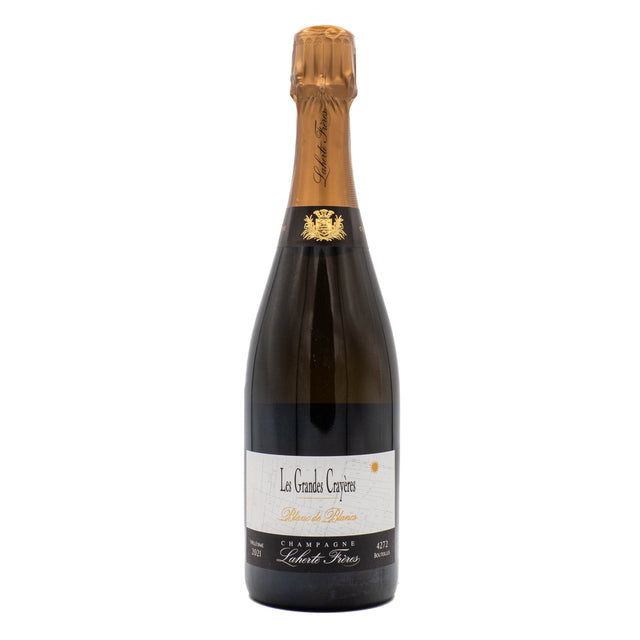
Champagne Laherte Frères Les Grandes Crayeres Blanc de Blancs Extra Brut 2021
We have 6 in stock (Inventory is live and accurate)
The Land
The name is a soil report. A crayère is a chalk pit, and Les Grandes Crayères sits on deep Champenois chalk carrying only a thin skin of clay and sand above it — enough dirt to hold a vine, not enough to soften what it tastes like. The parcel lies in Chavot, the village on the southern slopes below Épernay where the Laherte family has farmed since 1889. Chavot belongs to the Coteaux Sud d'Épernay, a stretch of hillside wedged between the Côte des Blancs to the south and the Vallée de la Marne to the north, and for most of the last century it was a place the big houses bought grapes from rather than a place anyone named on a label. That has changed, largely because of what comes out of parcels like this one.
The Wine
One lieu-dit, one grape, one year: Chardonnay only, from massale-selection vines that have been in the ground for decades, bottled as a single-parcel vintage cuvée every year since 2014. Hand-picked and traditionally pressed, fermented on native yeasts and raised in used 228-liter Burgundy barrels, with malolactic fermentation blocked so the chalk's acidity arrives unbuffered. It is bottled without fining or filtration and finished at two and a half grams per liter of dosage — close to nothing, which leaves the wine nowhere to hide. The 2021 growing season was among Champagne's hardest in a generation: spring frost, a cool and wet summer, punishing mildew pressure, sharply reduced yields. Well-drained chalk was where the good fruit survived. Disgorged in late 2024. White grapefruit, lemon oil, shortbread and hazelnut, and a long saline finish. The importer lists 4,272 bottles.
The People
Jean-Baptiste Laherte founded the house in Chavot in 1889. Six generations later Aurélien Laherte took the reins in 2005 and turned a competent family estate into one of the reference points for grower Champagne. The domaine covers roughly 10.5 hectares spread across more than seventy-five separate parcels, seven of those hectares certified organic and worked biodynamically, the balance farmed organically or sustainably without certification. Because French inheritance law scattered the family's vines among aunts, uncles and cousins, the Lahertes registered as a négociant simply so all the family fruit could stay in the family's wines. In 2009 Aurélien and his school friend Raphaël Bereche founded Terres et Vins de Champagne, the growers' collective that made tasting raw, unsparkling vins clairs a normal thing to do — an argument, effectively, that Champagne is wine first.
Food Pairing
Oysters on the half shell, where the wine's chalky salinity meets brine head-on instead of trying to sweeten it. Sole meunière, because two and a half grams of dosage and no malolactic softening gives the acid the edge it needs to cut brown butter. Fried smelts or tempura shrimp, where the mousse and acidity scour the fry oil clean between bites. And a wedge of aged Comté, whose crystalline nuttiness runs straight into the barrel-and-lees depth underneath the fruit. This is the bottle you open standing up, before anyone has sat down, and then wish you had bought two of.
We ship wine to most states with a $100 minimum order for shipping. We don't ship spirits nor beer.
Weather shipping advisory: Orders placed during times of extreme heat or extreme cold will be held for no charge until more favorable weather returns.
Champagne is the northernmost major wine region in France, defined by its cool climate, chalky soils, and centuries-old tradition of sparkling wine production. Centered around the towns of Reims and Épernay, the region is divided into key subzones like the Montagne de Reims, Vallée de la Marne, and Côte des Blancs, each favoring different grapes—Pinot Noir, Meunier, and Chardonnay respectively. The region’s signature chalk and limestone soils provide excellent drainage and impart a distinctive mineral character to the wines. While méthode champenoise was refined here in the 17th century, Champagne’s global prestige grew through the 19th and 20th centuries, cementing its role as the benchmark for sparkling wine worldwide.
Champagne

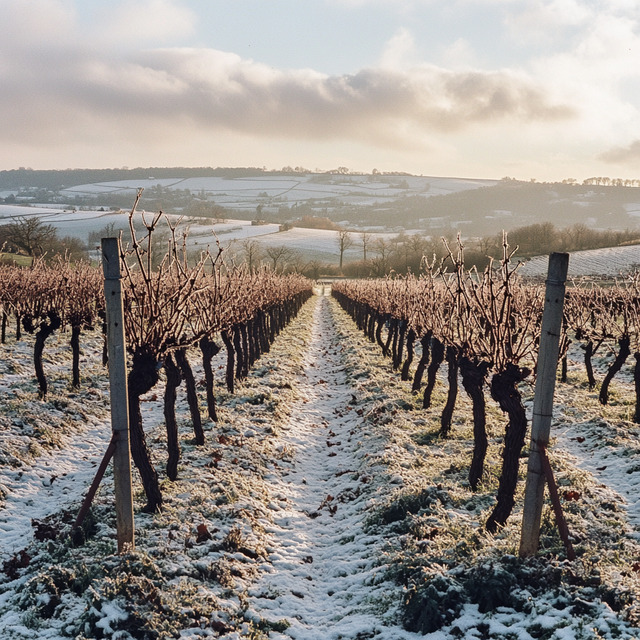
Chardonnay, one of the world's most versatile and beloved white grape varieties, showcases a remarkable spectrum of styles, from the lean, mineral-driven expressions of Chablis in France to the rich, buttery, and oak-aged versions from California's Napa Valley. Its adaptability extends to cooler climates such as Burgundy, where it achieves elegance and complexity, and to regions like Australia's Yarra Valley, known for producing vibrant and fruit-forward renditions. This grape's ability to reflect its terroir, coupled with winemaking techniques, results in a wide array of profiles, including unoaked, crisp varieties with apple and citrus notes, to full-bodied wines with tropical fruit flavors and creamy textures.