

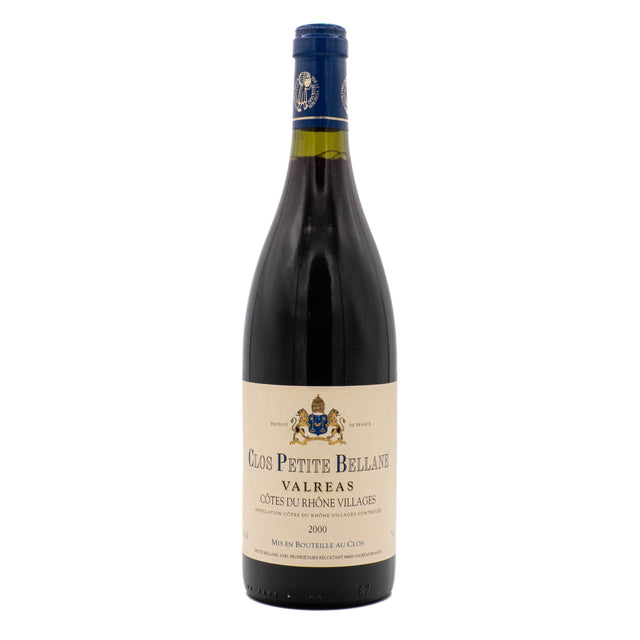
Clos Petite Bellane Cotes du Rhone Villages Valreas 2000
We have 3 in stock (Inventory is live and accurate)
The Land
Valréas is in the Vaucluse, but you cannot walk there from the Vaucluse. The town and its three neighbors form the Enclave des Papes, a detached exclave separated from the rest of the department by roughly 2.5 kilometers of Drôme on every side — the residue of fourteenth-century papal land purchases that began after John XXII tasted a Valréas wine in 1317 on his way to Avignon. The geography is not trivia. This is the northern edge of the southern Rhône and its coolest corner, with appellation vineyards averaging 245 meters and climbing to 532 at Mourre de Broche. Clos Petite Bellane sits at 410 meters on clay-limestone over the Vinsobres plateau, vines running between truffle woods and beehives, with the Ventoux and the Dentelles de Montmirail on the horizon. Altitude is why these wines keep.
The Wine
Grenache and Syrah, the estate's standard pairing for its Valréas bottling, though the exact 2000 percentages are not on record. The vintage was a strong one in the south: picking started in late August under dry skies, and the fruit came in healthy, thick-skinned and high in tannin. The caution attached to 2000 from the beginning was acidity — many wines were built for fifteen years, not twenty-five. Valréas altitude is the argument for this one. At twenty-six years expect a garnet-to-tawny rim, dried plum and fig, leather, tobacco leaf, dried thyme, and a faint cedar edge, with tannin fully melted and the finish savory rather than fruity. Stand it upright overnight, decant off the sediment without swirling, and drink within the hour. Serve at 60 to 62 degrees. Storage history matters more than the vintage chart here.
The People
The name on the label is worth getting right. Clos Petite Bellane was Olivier Peuchot's estate: he took over the vineyard around 1999 and was working roughly fifty hectares from a low, modern cellar tucked among trees in the middle of the vines. Peuchot's reds were the estate's calling card through the 2000s. In 2010 he sold the 48-hectare property to Stéphane Vedeau, who renamed it Clos Bellane, converted the farming to organic and earned Ecocert certification a few years later. This 2000 is entirely Peuchot's work, made a decade before any of that. It is a snapshot of the site before it became one of the reference addresses for cool-climate Côtes du Rhône Villages.
Food Pairing
Follow the estate's own truffle woods. Buttered pasta or soft polenta with shaved black truffle meets this wine on its tertiary, earthy register without asking anything of its tannin. Duck breast with a cherry or plum reduction picks up the dried stone fruit. A beef daube braised with orange peel and bay does the same in a heavier key. Roast chicken with wild mushrooms and thyme is the weeknight version. Open it on an evening when the cooking is the event.
We ship wine to most states with a $100 minimum order for shipping. We don't ship spirits nor beer.
Weather shipping advisory: Orders placed during times of extreme heat or extreme cold will be held for no charge until more favorable weather returns.
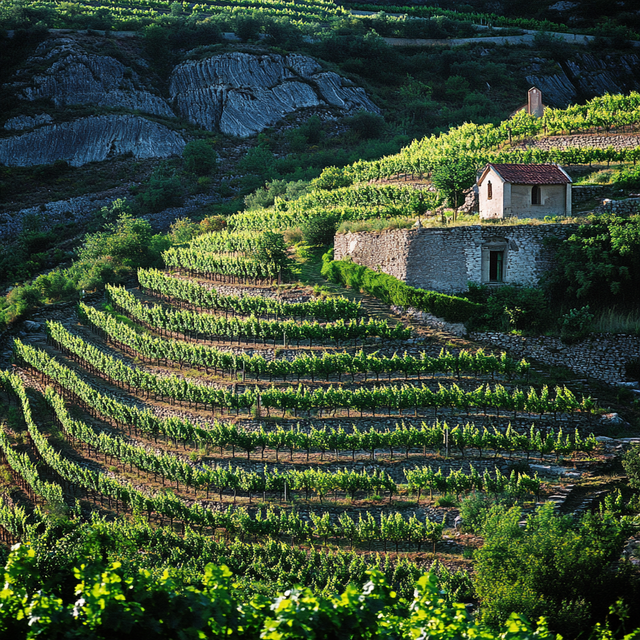
The Rhône Valley is a diverse and historic wine region, divided into two distinct areas. The Northern Rhône is the birthplace of Syrah, with steep, terraced vineyards that produce some of the world's most revered wines, such as those from Hermitage and Côte-Rôtie. The Southern Rhône is much more expansive, offering a wider range of styles, but typically based around Grenache-based blends, with wines from Châteauneuf-du-Pape known for their complexity and power. While the region is celebrated for its reds, it also produces incredible textured whites, and as a whole the region displays the spectrum of French wine and the incredible differences that can come from small geographic changes.
Rhone Valley

Grenache is a widely planted grape variety that thrives in its Mediterranean home. In Spain, it's known as Garnacha, where it reaches its peak in the Sierra de Gredos as a pure varietal wine, while also being a key blending component in Rioja. France's Southern Rhône, notably Châteauneuf-du-Pape, is another well-known region, where Grenache is often the base of a blended wine. Grenache also finds a home in Sardinia as Cannonau, and it has spread beyond its Mediterranean origins, most famously to Australia's Barossa Valley. The resulting wines are typically light in color, yet they possess a full body and flavor, displaying mature red fruit notes, herbal spices, and often a hint of orange peel, along with soft tannins and moderate acidity. It is an incredibly versatile grape, showing different expressions based on its terroir and the winemaking style employed.