Skip to content
Welcome to Colorado's best wine shop!

Joseph & Philippe Roty Marsannay Cuvée de Boivin 2022

$68.00

We have 7 in stock (Inventory is live and accurate)

Select Title

We ship wine to most states with a $100 minimum order for shipping. We don't ship spirits nor beer.

Weather shipping advisory: Orders placed during times of extreme heat or extreme cold will be held for no charge until more favorable weather returns.

0 / 0
The Producer

Domaine Joseph Roty


The Terroir

Roty's Charmes-Chambertin parcel was planted in 1881, as growers were first replanting on grafted rootstock against phylloxera, and about 60 percent of those original vines still produce. Few Gevrey estates have older vines on average; Roty's run around 60 to 65 years. The Griotte-Chambertin vines are about 100 years old and usually give one barrel, and part of the Mazy-Chambertin, next to Dugat-Py's holding, dates from 1918. Below the grand crus, the Clos Prieur Bas parcel sits at the southern end of the lieu-dit, beside the premier cru and Armand Rousseau, on clay and Bajocian limestone much like Charmes.

The domaine farms about 8.5 hectares across Gevrey, Marsannay and Brochon. In Marsannay, Champs St. Étienne is a lieu-dit that nuns replanted in the 1600s, and Roty is the only producer printing its name on a label. The Pressonnier parcel lies across the main road from Clos Prieur and sat inside the Gevrey appellation until 1964. Yields run 25 to 30 hectoliters per hectare.

The Rotys have been in Gevrey since 1710, and the domaine still works the way Burgundy did decades ago. "Nothing changes," Madame Roty told the US importer Skurnik. Charles Roty began estate bottling, and from the late 1960s his grandson Joseph built today's holdings around old vines inherited in Charmes, Mazy and Griotte. Joseph set the house style: full destemming, a week of cold soak, fermentation below 30°C, no filtration, and plenty of new oak, from 30 to 50 percent for villages wines up to 80 to 100 percent for grand crus. Young wines show the oak, and warm years can pass 14 percent alcohol. The family was among the first in Burgundy to sell only bottled wine.

Joseph's elder son Philippe worked beside him from about 1990. Until 2014 some wines carried a separate Domaine Philippe Roty label, so older bottles read Joseph Roty, Philippe Roty, or Joseph & Philippe Roty. Joseph died in 2008 and Philippe in 2015, aged 46. Their younger brother Pierre-Jean, the 11th generation, now runs the domaine with his mother and sister Patricia.

  • Charmes-Chambertin Cuvée Très Vieilles Vignes Pinot Noir from the 1881 planting, the domaine's oldest holding, with about 60 percent of the original vines still in place. The small, millerand berries are usually picked first, and the wine goes into 80 to 100 percent new oak. It has a 50-year record as a cellar wine, and Burgundy Report puts its next level at 20 to 25 years.
  • Mazy-Chambertin Pinot Noir from a grand cru parcel next to Dugat-Py's, with a section planted in 1918, raised in new oak. Production is tiny, and the label keeps the old "Mazy" spelling.
  • Griotte-Chambertin Pinot Noir from vines about 100 years old that give about one barrel a year, and 1.25 barrels in 2019 and 2020. It is the domaine's rarest wine.
  • Gevrey-Chambertin 1er Cru Les Fontenys Pinot Noir from about half a hectare in a warm hollow beside Bruno Clair's holding, among the first Pinot Noir in the appellation to be picked. It is the domaine's one premier cru, and it is made for the cellar.
  • Gevrey-Chambertin Clos Prieur Bas Pinot Noir from the village-level lower half of Clos Prieur, at its southern end beside the premier cru and Armand Rousseau. The soil is clay over Bajocian limestone, close to that of Charmes-Chambertin.
  • Gevrey-Chambertin La Brunelle Pinot Noir from a 0.17-hectare walled vineyard behind the domaine buildings, planted in 1960 by Pierre-Jean's father and grandfather. The plot is warm and humid and always harvested first. Roty is its only producer, and it is the darkest and most intense of the Gevrey villages wines.
  • Gevrey-Chambertin Champs Chenys Pinot Noir from five parcels directly below Charmes-Chambertin, the oldest planted in 1934 on ungrafted roots.
  • Gevrey-Chambertin Pinot Noir blended from four parcels, just over a hectare, in central Gevrey. Since 2022 some of the La Justice fruit has been bottled on its own as Cuvée de la Justice.
  • Marsannay Rouge Champs St. Etienne Pinot Noir from about 0.75 hectares mid-slope, with vines over 50 years old. Roty is the only producer to put the lieu-dit on a label.
  • Marsannay Cuvée de Boivin Pinot Noir from the heart of the appellation. It is the domaine's only goblet-trained parcel, with five arms per vine, now slowly moving to a Y shape.
  • Marsannay Clos de Jeu Pinot Noir from a parcel near the center of the appellation, aged in barrel.
  • Marsannay Pinot Noir blended from five parcels (Quartier, Ronsoy, Favières, Rosey and Bas de Longeroies) averaging about 50 years old, aged 18 months with about 40 percent new oak. It is the best single read on a Roty vintage.
  • Marsannay Blanc 100 percent Chardonnay from the Boivin and Champs St. Étienne parcels, with only about 5 percent new oak. The style runs ripe, toward pear.
  • Côte de Nuits-Villages Rouge Pinot Noir from Brochon, just north of Gevrey. Through 2020 it came from Queue de Hareng, high on the slope at the forest edge. From 2022 it comes from 0.33 hectares of roughly 70-year-old vines in La Croix Violette, behind the Château de Brochon, aged with about 50 percent new oak.
  • Bourgogne Pressonnier Pinot Noir from a parcel across the main road from Clos Prieur that was Gevrey-Chambertin until 1964, with vines planted between 1925 and 2012 and no new oak. It is Gevrey in all but name.
  • Bourgogne Blanc 80 percent Pinot Blanc, planted in 1990 at Jean-François Coche-Dury's suggestion, and 20 percent Chardonnay, from parcels in Gevrey and Marsannay, aged in barrel. The Pinot Blanc gives the wine a broader, fatter core.
  • Bourgogne Aligoté Aligoté that usually sells out before the domaine shows the rest of the range to the trade.
  • Marsannay Rosé Pinot Noir from vines averaging over 50 years in two lieux-dits, pressed directly after a couple of hours' skin contact, then aged about 15 months in one- and two-year-old barrels. It is built for the table and for some aging.

Shop all Domaine Joseph Roty (5)

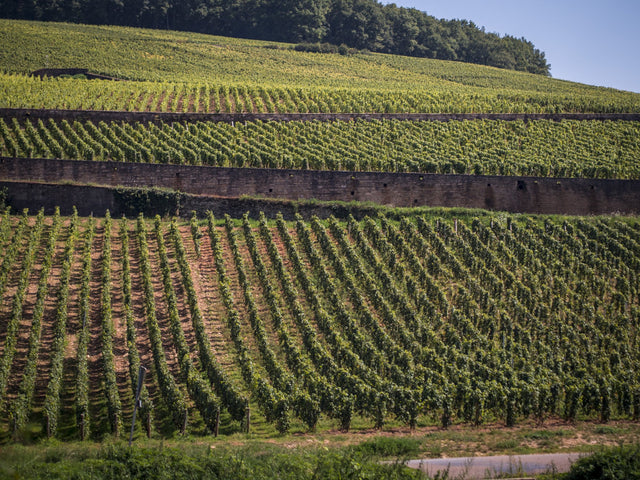
Burgundy, in eastern France, encompasses several subregions, but it is the Côte d'Or that is home to many of the world's most expensive and revered wines. The region, primarily a single east-facing slope, has mixed limestone soils that vary dramatically from village to village and even vineyard to vineyard. White wines, crafted from Chardonnay, range from rich and opulent to lean and intensely mineral, while Pinot Noir produces silky, perfumed red wines of exceptional finesse and complexity. Centuries of winemaking tradition have resulted in every plot being meticulously recognized and scrutinized, making the Côte d'Or a true capital of terroir.

Burgundy - Cote d'Or


Pinot Noir is a thin-skinned, notoriously difficult-to-grow, low-yielding grape that finds its ancestral home in Burgundy, France, where it produces some of the world's most elegant and nuanced wines. While Burgundy remains its spiritual heartland, Pinot Noir has since traveled the globe, finding success in other cooler climates, notably in California, Oregon, New Zealand, and Germany. This grape is a challenge for any grower, as it requires specific conditions to show its best, and yet the wines it produces are capable of such a captivating and singular character.
Pinot Noir