Skip to content
Welcome to Colorado's best wine shop!

Domaine Lucien Muzard Pommard Les Cras Vieilles Vignes 2022

$85.00

We have 7 in stock (Inventory is live and accurate)

Select Title

We ship wine to most states with a $100 minimum order for shipping. We don't ship spirits nor beer.

Weather shipping advisory: Orders placed during times of extreme heat or extreme cold will be held for no charge until more favorable weather returns.

0 / 0
The Producer

Domaine Lucien Muzard


The Terroir

Two of the Muzards' oldest plantings are village sites outside Santenay. The 31 ares of Pommard Les Cras, at the bottom of the Pommard slope near the Volnay line, average more than 80 years on deep, stony fine clay over limestone. In Meursault Les Meix Chavaux, 0.75 hectares at mid-slope facing south-southwest on limestone-dominant clay, the oldest section went in during 1935.

Most of the 18 hectares are in Santenay. La Maladière is the largest holding at 4.35 hectares, a steep, stony southeast-facing slope of fissured limestone under a thin layer of marl. Clos Faubard, 1.83 hectares, sits high on the slope at about 300 meters on lean soil with more limestone showing. The 62 ares of Gravières face east on marl-limestone studded with chert and were planted in the early 1960s. Champs Claude, a village site, lies at the foot of Chassagne's Morgeot on clay-marl where the plow reaches limestone. South toward Maranges, the domaine's 54 ares were planted in 1963 on deep red clay in a cold sector at the bottom of the slope.

The Muzards trace winegrowing in Santenay to a 1645 deed recording a grape sale to a Beaune wine house. The domaine as it stands today was built by Lucien Muzard and his wife, Paule, who bought land and planted vines, starting from 2 hectares. Their elder son, Claude, began working the estate at 12 and joined full time in 1987; Hervé followed about three years later. The brothers took over in the 1990s and moved the family from selling to the négoce to bottling under its own name.

Hervé runs the vineyards and Claude the élevage through bottling. They gave up herbicides, went back to working the soil, pulled out overly productive vines to replant lower-yielding ones, and planted trees and hedges around their parcels. The domaine now calls its approach viticulture raisonnée while keeping organic practices day to day. Claude's daughter Capucine, trained in viticulture and enology in Beaune, joined full time in 2019 as the tenth generation and handles the domaine's communication.

Reds are never crushed, keep about 30% whole clusters, ferment on native yeasts for 18 to 20 days in temperature-controlled concrete, and age about 12 months in 228-liter barrels, 15 to 20% new. Since 2014, foudres have returned for the key cuvées. Whites ferment on native yeasts in 350-liter barrels.

  • Pommard Les Cras Vieilles Vignes Pinot Noir from 31 ares at the foot of the Pommard slope, vines averaging over 80 years on deep, stony clay over limestone. About 30% whole clusters and barrels with 15% new. It carries a village label, and the vine age is the reason to buy it.
  • Santenay Champs Claude Vieilles Vignes Pinot Noir from 1.49 hectares of vines averaging over 70 years, on a gentle east-facing slope of clay-marl at the foot of Chassagne's Morgeot. Aged in barrels with 15 to 20% new. Old-vine density at village price.
  • Meursault Les Meix Chavaux Chardonnay from 0.75 hectares bought in 2011, with plantings from 1935, 1988 and 2001 at mid-slope facing south-southwest. Native-yeast fermentation and aging in 350-liter barrels, with malolactic over winter in the underground cellar, keeps the oak in the background.
  • Santenay 1er Cru La Maladière Pinot Noir from the domaine's largest holding, 4.35 hectares of steep, stony, southeast-facing limestone under thin marl. One third ages in foudre and the rest in barrels with 15 to 20% new.
  • Santenay 1er Cru Clos Faubard Pinot Noir from 1.83 hectares on the upper slope at about 300 meters, facing southeast on lean, limestone-rich soil above Gravières. Barrels with 15 to 20% new.
  • Santenay 1er Cru Gravières Pinot Noir from 62 ares planted in the early 1960s, facing east on marl-limestone with chert. Burgundy Report found it perfumed and red-fruited with modest tannin.
  • Santenay 1er Cru Clos des Mouches Pinot Noir from a south-facing slope with shallow soil over Jurassic oolitic limestone, planted in the early 1980s. Part of the élevage is in foudre, the rest in barrels with 15% new.
  • Santenay 1er Cru Clos de Tavannes Pinot Noir from 42 ares planted in 1989, facing east on marl-limestone. Barrels with 15% new; Burgundy Report compared its darker profile to Volnay.
  • Santenay 1er Cru Beauregard Pinot Noir from thin soil over mixed limestone, and the domaine's only cuvée made with 100% whole clusters. Barrels with 15 to 20% new; Burgundy Report suggested at least five years in the cellar.
  • Santenay Vieilles Vignes Pinot Noir blended from 3 hectares in three parcels near Chassagne, in the village center and toward Maranges, with vines averaging over 60 years on east-facing clay-marl. Aged partly in barrel, 15 to 20% new, and partly in tank or foudre to keep it fresh.
  • Maranges Pinot Noir from 54 ares planted in 1963 on deep red clay in a cold sector at the foot of the slope. Barrels with 15 to 20% new plus some tank aging.
  • Chassagne-Montrachet Vieilles Vignes Red from a 24-are parcel of vines over 70 years old on marl near Morgeot, among the domaine's oldest. Barrels with 15% new.
  • Santenay Champs Claude Blanc Chardonnay from about 1.5 hectares planted in 1990, facing east 20 meters below Morgeot. Ten months in 350-liter barrels with one third in foudre.
  • Santenay 1er Cru La Maladière Blanc Chardonnay from 57 ares planted in 2013 on the same stony southeast-facing limestone as the red. Native yeasts and 350-liter barrels.
  • Chassagne-Montrachet Blanc A microcuvée from 10 ares on marl and limestone, fermented on native yeasts in 350-liter barrels.

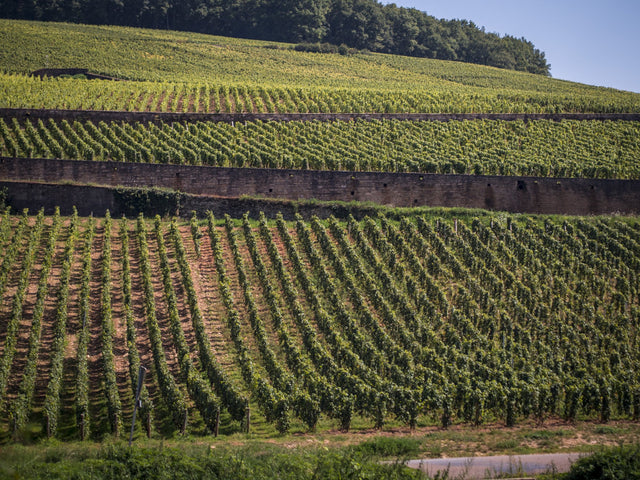
Burgundy, in eastern France, encompasses several subregions, but it is the Côte d'Or that is home to many of the world's most expensive and revered wines. The region, primarily a single east-facing slope, has mixed limestone soils that vary dramatically from village to village and even vineyard to vineyard. White wines, crafted from Chardonnay, range from rich and opulent to lean and intensely mineral, while Pinot Noir produces silky, perfumed red wines of exceptional finesse and complexity. Centuries of winemaking tradition have resulted in every plot being meticulously recognized and scrutinized, making the Côte d'Or a true capital of terroir.

Burgundy - Cote d'Or


Pinot Noir is a thin-skinned, notoriously difficult-to-grow, low-yielding grape that finds its ancestral home in Burgundy, France, where it produces some of the world's most elegant and nuanced wines. While Burgundy remains its spiritual heartland, Pinot Noir has since traveled the globe, finding success in other cooler climates, notably in California, Oregon, New Zealand, and Germany. This grape is a challenge for any grower, as it requires specific conditions to show its best, and yet the wines it produces are capable of such a captivating and singular character.
Pinot Noir