Skip to content
Welcome to Colorado's best wine shop!

Domaine Dujac “Echezeaux” Grand Cru 2019

$1,150.00

We have 2 in stock (Inventory is live and accurate)

Select Title

We ship wine to most states with a $100 minimum order for shipping. We don't ship spirits nor beer.

Weather shipping advisory: Orders placed during times of extreme heat or extreme cold will be held for no charge until more favorable weather returns.

0 / 0
The Producer

Domaine Dujac


The Terroir

Dujac's largest grand cru holding sits on two kinds of rock. Its 1.95 hectares of Clos de la Roche face east at 276 to 308 meters on Prémeaux limestone and Comblanchien scree, and make the most structured, tannic wine in the cellar. Clos Saint-Denis, just to the south at 284 to 309 meters, gives silkier tannins and more lift. Across the Gevrey line, Aux Combottes is a 1.15-hectare premier cru on crinoidal limestone, wedged between Latricières-Chambertin and Clos de la Roche at 271 to 282 meters.

The 2005 purchase pushed the domaine south into Vosne-Romanée: 1.57 hectares of Aux Malconsorts, the premier cru that borders La Tâche, and 0.73 hectares of Les Beaux Monts, plus small pieces of Chambertin and Romanée-Saint-Vivant. Echezeaux comes from 0.69 hectares in the Champs Traversins section. Since 2014, long-term leases in Puligny-Montrachet, including 1.18 hectares of Les Folatières, have given the domaine its first Côte de Beaune whites.

Dujac began with a sale. In 1959 Domaine Marcel Graillet sold its best premier cru, Clos de la Bussière, to Georges Roumier. Nine years later the remaining 4.5 hectares, in Clos de la Roche, Clos Saint-Denis and Aux Combottes, went to Jacques Seysses, a former banker in New York and Paris whose father, Louis, ran a biscuit factory and backed the deal. Seysses had worked vintages with Gérard Potel at Domaine de la Pousse d'Or in Volnay. He renamed it Dujac, from "du Jacques," sold the 1968 crop to négociants and bottled from 1969, fermenting every cuvée as whole clusters, the house signature.

His sons Jeremy (joined 1998) and Alec (2003) and Jeremy's wife, Diana Snowden Seysses (2001), a UC Davis-trained enologist from the Snowden Vineyards family in Napa, now run it, with Jacques advising. They destem a little more than he did, often 10 to 15 percent, and adjust by vintage and site. Organic trials began on 4 hectares in 2001. The whole estate has been farmed organically since 2008, with biodynamic preparations in use since 2003.

Grand Crus

  • Clos de la Roche Grand Cru Pinot Noir from 1.95 hectares on limestone and scree, the domaine's largest grand cru holding. Fermented largely as whole clusters and aged up to 100 percent new oak, it is the most structured, tannic wine Dujac makes.
  • Clos Saint-Denis Grand Cru Pinot Noir from about 1.1 hectares downslope of Ponsot plus 0.37 hectares in the lieu-dit Calouère. Silkier tannins and more aromatic lift than the Clos de la Roche next door.
  • Charmes-Chambertin Grand Cru Pinot Noir from 0.70 hectares bought in stages from the 1970s, split between the Mazoyères sector and Charmes proper.
  • Echezeaux Grand Cru Pinot Noir from 0.69 hectares in Champs Traversins, vines planted north-south. In 2019 only 10 to 15 percent of the fruit was destemmed.
  • Bonnes-Mares Grand Cru Pinot Noir from two parcels, 0.58 hectares in 2009: one on heavy red clay, one on chalky white soil near the top of the slope that came with the 2005 purchase.
  • Chambertin Grand Cru Pinot Noir from about 0.29 hectares, mostly in Clos de Bèze beside Rousseau's vines, acquired in 2005. Made in tiny quantities.
  • Romanée-Saint-Vivant Grand Cru Pinot Noir from 0.16 hectares downslope of Romanée-Conti, next to Cathiard, acquired from Moillard in 2005.

Premier Crus

  • Gevrey-Chambertin 1er Cru Aux Combottes Pinot Noir from 1.15 hectares between Latricières-Chambertin and Clos de la Roche, planted mainly in 1987 and 1991. Jeremy Seysses has said whole-cluster spice can read as gimmicky in Gevrey, so stem use here is decided parcel by parcel.
  • Vosne-Romanée 1er Cru Aux Malconsorts Pinot Noir from 1.57 hectares in the premier cru that borders La Tâche, in the family since the 2005 Thomas-Moillard purchase. Aged in 60 to 80 percent new oak, like the other premier crus.
  • Vosne-Romanée 1er Cru Les Beaux Monts Pinot Noir from 0.73 hectares, also part of the 2005 purchase. Whole clusters and new casks give it smoky, dark-fruited aromas.
  • Morey-Saint-Denis 1er Cru Pinot Noir blended mostly from Les Ruchots, with Clos Sorbé, Les Millandes and other lieux-dits.
  • Chambolle-Musigny 1er Cru Les Gruenchers Pinot Noir from 0.32 hectares of pre-clonal vines, about 60 years old in 2009, that give small berries and small bunches.

Village wines and whites

  • Morey-Saint-Denis Pinot Noir from the domaine's home village, from lieux-dits including Porroux, Le Village, Clos Solon and Les Herbuottes. Aged in about 40 percent new oak.
  • Chambolle-Musigny Pinot Noir from 0.64 hectares (2009) of village-level Chambolle. Village fruit is destemmed more than the grand crus, which keeps it fresher in youth.
  • Morey-Saint-Denis Blanc Chardonnay from Les Davreaux, on vines planted after the 1985 frost between the Seysses house and the RN74 road. Lightly crushed and aged without lees stirring.
  • Morey-Saint-Denis 1er Cru Monts Luisants Blanc Chardonnay from 0.6 hectares Dujac rents in Monts Luisants, with more depth than the village Blanc.
  • Puligny-Montrachet 1er Cru Les Folatières Chardonnay from 1.18 hectares held on a long-term lease since 2014, the domaine's first Côte de Beaune vineyard.
  • Puligny-Montrachet 1er Cru Les Combettes Chardonnay from a second premier cru leased in 2014, on vines about 60 years old whose planting records were lost.

Dujac Fils & Père

A separate négoce label Jeremy and Jacques Seysses started in 2000. Grapes come from partner growers in Gevrey, Morey and Chambolle; the Dujac team sets farming, yields and picking dates, and the wines see about 50 percent new oak.

  • Fils & Père Gevrey-Chambertin Village Pinot Noir from purchased Gevrey fruit, made in the Dujac cellar in a fruit-forward style for earlier drinking.
  • Fils & Père Nuits-Saint-Georges 1er Cru Les Cras Premier cru Pinot Noir from purchased Nuits-Saint-Georges fruit, an appellation the domaine itself does not own.

Shop all Domaine Dujac (7)

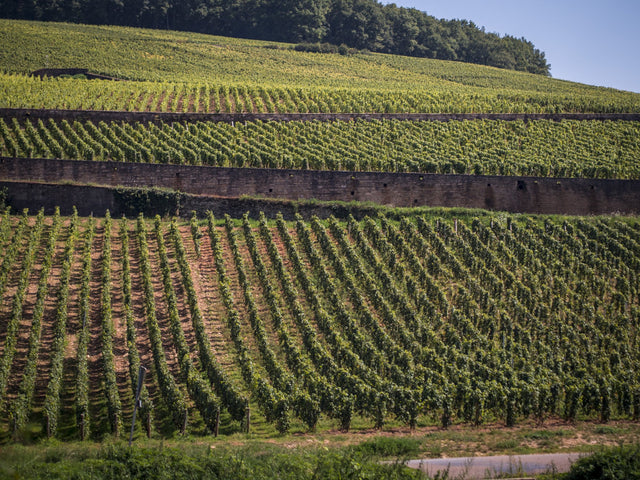
Burgundy, in eastern France, encompasses several subregions, but it is the Côte d'Or that is home to many of the world's most expensive and revered wines. The region, primarily a single east-facing slope, has mixed limestone soils that vary dramatically from village to village and even vineyard to vineyard. White wines, crafted from Chardonnay, range from rich and opulent to lean and intensely mineral, while Pinot Noir produces silky, perfumed red wines of exceptional finesse and complexity. Centuries of winemaking tradition have resulted in every plot being meticulously recognized and scrutinized, making the Côte d'Or a true capital of terroir.

Burgundy - Cote d'Or


Pinot Noir is a thin-skinned, notoriously difficult-to-grow, low-yielding grape that finds its ancestral home in Burgundy, France, where it produces some of the world's most elegant and nuanced wines. While Burgundy remains its spiritual heartland, Pinot Noir has since traveled the globe, finding success in other cooler climates, notably in California, Oregon, New Zealand, and Germany. This grape is a challenge for any grower, as it requires specific conditions to show its best, and yet the wines it produces are capable of such a captivating and singular character.
Pinot Noir