

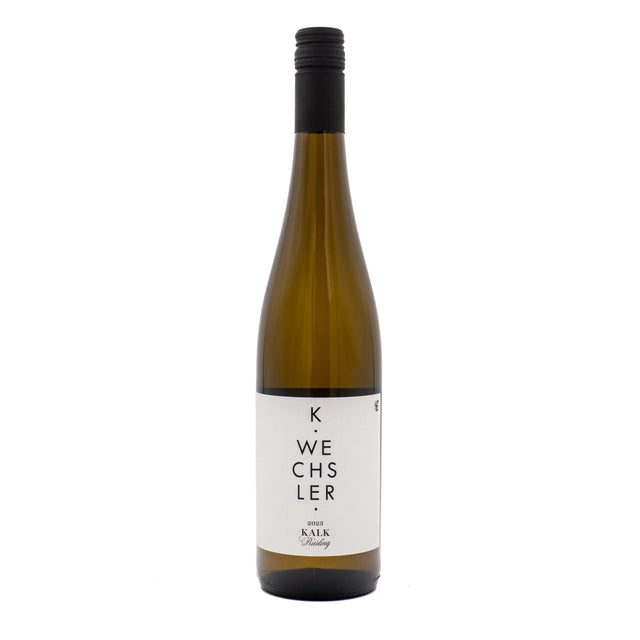
Wechsler Riesling Kalk 2023
We have 11 in stock (Inventory is live and accurate)
The Land
Kalk is German for limestone, and the name refers to geology far older than Riesling. Millions of years ago the Mainz Basin was a shallow sea, and the calcium carbonate remains of its creatures settled into the bedrock that now underlies Westhofen's best sites. Above that rock sit shifting mixes of loess, clay marl, and calcareous clay. Katharina Wechsler farms parcels in Kirchspiel, Morstein, and the family monopole Benn, where loess covers the lower slope near 120 meters and limestone takes over higher up, toward 160. Earlier releases of Kalk came from her Kirchspiel parcels on a gentle southeast-facing slope at about 160 meters. Limestone tends to give Riesling a chalky texture and a finish that reads more saline than fruity, which is exactly what this bottling is built to show.
The Wine
Wechsler Riesling Kalk 2023 is 100 percent Riesling, hand-picked in several passes. The grapes macerate on their skins for a matter of hours before pressing; Wechsler sets the time each year by parcel, ripeness, and acidity. Fermentation starts on its own in stainless steel, with a neutral cultured yeast held back only for stubborn tanks, and she caps fermentation temperatures to keep the site in front. The wine then rests on its lees in steel, unfined, before a light filtration. The 2023 comes in at 12.5 percent alcohol. Expect yellow plum, lemon, wild herbs, and crushed chalk on the nose, a taut, salty line through the middle, and a finish that turns creamy as the lees texture shows. This is limestone Riesling from Rheinhessen in its plainest, most direct form.
The People
Katharina Wechsler was working as a junior editor at a Berlin television station when weekly phone calls with her mother pulled her home to Westhofen. The family estate dates to the 18th century but spent generations selling bulk wine and growing grain and vegetables to offset crop losses. She began winemaking school in Oppenheim in 2009, graduating in 2012, and worked harvests at Weingut Gutzler and with Klaus-Peter Keller, Westhofen's most famous grower. She took over officially in 2017, renamed the estate after herself, and turned it from volume to terroir. The vineyards have been certified organic since the 2021 vintage, with biodynamic practices since 2020: compost of horse manure, pomace, and green waste, and more than 30 herbs sown between the rows.
Food Pairing
Kalk's salt and chalk want food from the water. Grilled sardines with lemon and parsley work because the acidity cuts the oily fish and the salinity echoes the char. Spring pea and ricotta crostini with mint and olive oil plays on the wine's herbal side. Vietnamese summer rolls with shrimp and a lime and fish sauce dip match acid with acid. A dozen raw oysters on ice is the purest pairing of all, mineral against mineral. This is the Riesling to pour for friends who swear they don't like Riesling.
We ship wine to most states with a $100 minimum order for shipping. We don't ship spirits nor beer.
Weather shipping advisory: Orders placed during times of extreme heat or extreme cold will be held for no charge until more favorable weather returns.
Rheinhessen, Germany's largest wine region by volume, is experiencing a quality revolution, led by producers like Weingut Keller. Once known for bulk wine, it's now gaining recognition for its dry Rieslings, particularly from the famed Roter Hang (Red Slope). This area, with its unique red clay and slate soils, is a source of intensely mineral and age-worthy wines. Rheinhessen, with its rolling hills and varied soils, also produces a diverse range of styles beyond the Roter Hang, often richer and broader than Mosel or Saar wines, while retaining vibrant acidity. The region is quickly establishing itself as a source of high-quality dry Riesling, showcasing a compelling and evolving side of German winemaking.
Germany - Rheinhessen

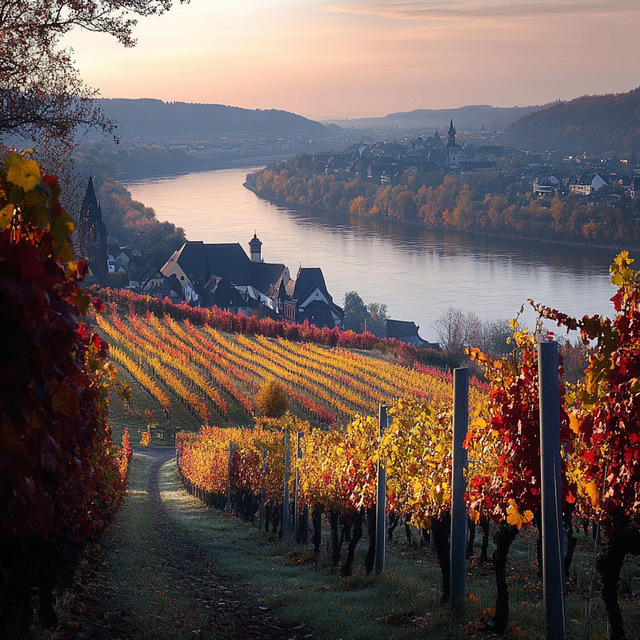
Riesling is a truly noble grape, known for its incredibly high acidity and a flavor profile that can range from bone dry to lusciously sweet. Germany is its heartland, and it's responsible for some of the world's most age-worthy examples, but Riesling also thrives in Austria, where it usually is dry. In Alsace, it takes on a slightly richer texture, while in parts of Australia, like the Clare and Eden Valleys, it displays a uniquely powerful and lime-tinged aromatic profile. This is a grape that has no problem showcasing its origins, and it's a fantastic example of how one variety can show many different expressions, each with its own unique appeal.