

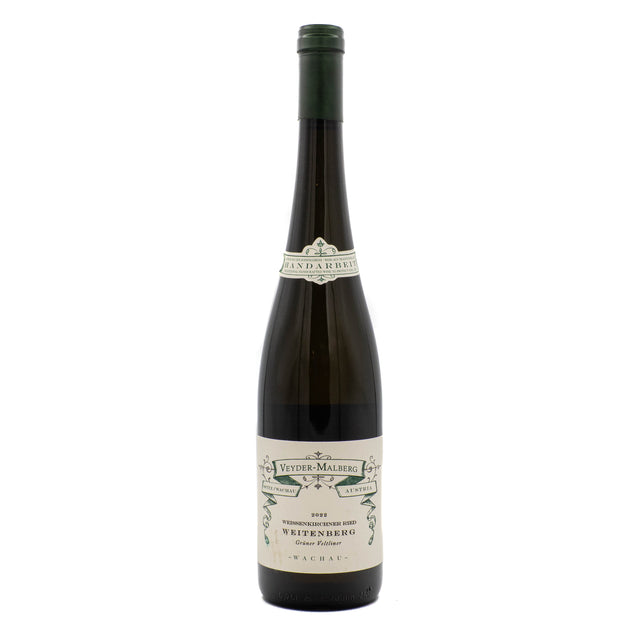
Veyder-Malberg Gruner Veltliner Weissenkirchner Weitenberg 2022
We have 6 in stock (Inventory is live and accurate)
The Land
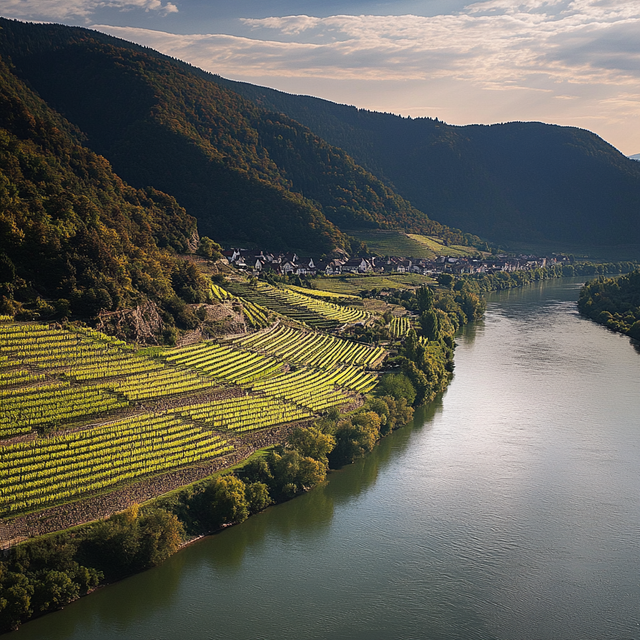
In the Wachau, Grüner Veltliner usually gets the lower, flatter ground on deep loess, while Riesling takes the rocky terraces above. Weitenberg breaks the pattern. This vineyard northwest of Weissenkirchen is a set of steep south- to southwest-facing stone terraces at about 320 meters, on orthogneiss and mica schist, the same hard rock that usually carries the valley's best Rieslings. Grüner Veltliner rooted in rock rather than loess gives up some of its trademark white pepper and gains a firm, stony cut. The terraces sit above the Danube in the middle of the valley, warm enough by day to ripen the grape fully, with cool nights coming off the forested hills behind. This is Grüner Veltliner from the Wachau built on structure rather than weight.
The Wine
The Veyder-Malberg Grüner Veltliner Weissenkirchner Weitenberg 2022 is 100 percent Grüner Veltliner from vines planted in the early 1950s from an old massal selection. The grapes macerate on their skins for up to 24 hours, then press slowly over six to eight hours, settle a day and ferment spontaneously at up to 24°C. Unlike the estate's Rieslings, Weitenberg goes through malolactic, and the wine ages nine months, until spring, in an old 1,500-liter Stockinger cask. Malolactic and big neutral wood give it a creamier middle with no oak flavor. Expect ripe pear, lemon peel and yellow apple, with crushed rock and a faint green-herb lift, then a dense, dry body and a long finish of wet stone and citrus pith. 2022 brought a hot, dry July and early August, then a wet September with high rot pressure in Grüner Veltliner, and the wines show lower alcohol and good acidity.
The People
Nowhere on a Veyder-Malberg label will you find the words Steinfeder, Federspiel or Smaragd. Those are the Vinea Wachau association's ripeness categories, and they rank wines by must weight and alcohol. Peter Veyder-Malberg works outside that system. "I don't believe that higher sugar levels mean higher quality," he has said, and he names his wines after the vineyards instead. He picks early, often ahead of his neighbors, judging ripeness by tasting the seeds rather than reading a refractometer. Before founding his Spitz estate in 2008 he spent 14 years running the vineyards and cellar at Graf Hardegg in the Weinviertel. Today he farms a patchwork of old hand-worked terraces organically and without irrigation, and Weitenberg, with the oldest vines he owns, is the Grüner Veltliner that makes his case best.
Food Pairing
Pour it around 50 to 54 degrees. Grüner Veltliner and asparagus is a classic pairing, so try white asparagus with boiled potatoes, ham and a lemony hollandaise; the wine's acidity cuts the sauce and its herbal edge meets the vegetable. Chicken paprikash with buttered noodles works because the creamy texture matches the sauce while the stony finish keeps it fresh. Try salmon crudo with lime, olive oil and flaky salt, where the citrus-pith finish meets the fish. This is the Grüner to pour when someone tells you the grape only makes simple wine.
We ship wine to most states with a $100 minimum order for shipping. We don't ship spirits nor beer.
Weather shipping advisory: Orders placed during times of extreme heat or extreme cold will be held for no charge until more favorable weather returns.
The Wachau, widely considered Austria's premier wine region, is a breathtakingly beautiful valley along the Danube River, renowned for its powerful and dry expressions of both Grüner Veltliner and Riesling. These two grapes are the stars here, producing wines that are typically full-bodied and structured, yet always maintain a signature Austrian freshness. The Wachau is unique in its own ripeness scale to categorize its wines: Steinfeder, a rarely seen lighter style, Federspiel, representing a balanced ripeness with vibrant acidity, and Smaragd, indicating riper, more exotic fruit, sometimes with a touch of botrytis depending on the producer's style. This region, with its steep, terraced vineyards and unique microclimates, is home to a concentration of Austria's very best producers, crafting wines that are benchmarks for both Grüner Veltliner and Riesling globally.
Austria - Wachau

Grüner Veltliner is Austria's signature grape, producing distinctive dry white wines celebrated for their vibrant character. Primarily grown in regions like Wachau, Kremstal, and Kamptal, Grüner Veltliner is known for its high acidity and a compelling savory edge, often displaying notes of white pepper and spice alongside green and citrus fruit. The wines are typically medium-bodied and exceptionally food-friendly, offering a unique combination of freshness and complexity. Grüner Veltliner is a grape that is clearly expressive of its origins, and it is a cornerstone of Austrian winemaking excellence.