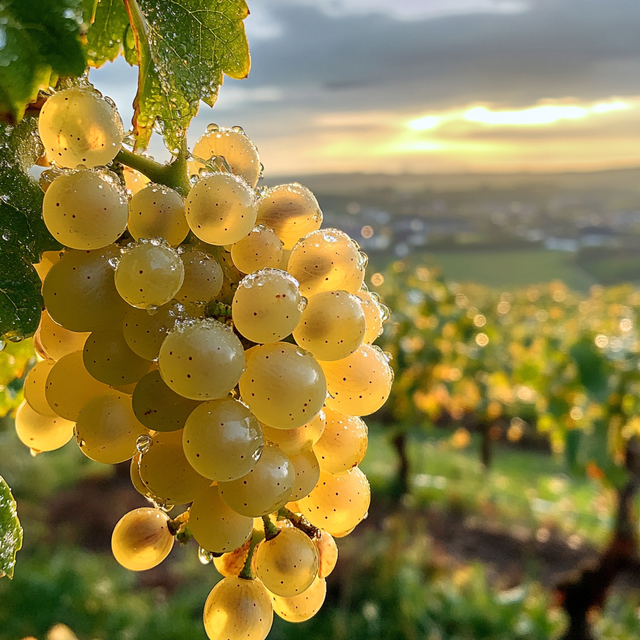


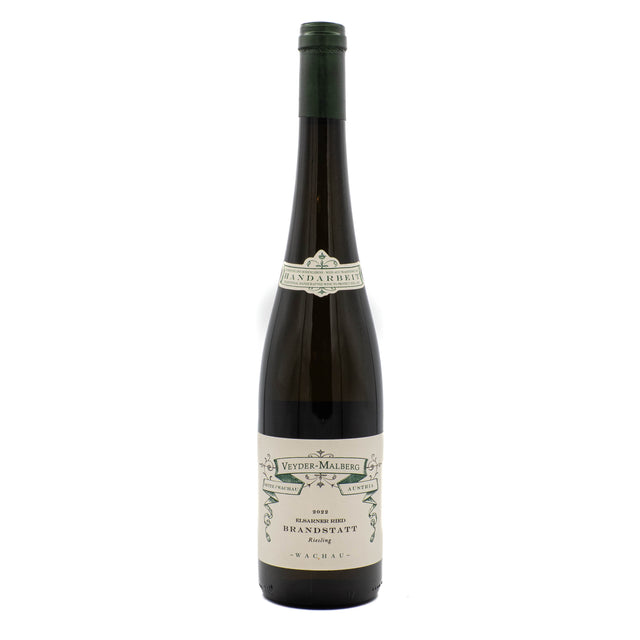
Veyder-Malberg Riesling Elsarner Brandstatter 2022
We have 5 in stock (Inventory is live and accurate)
The Land
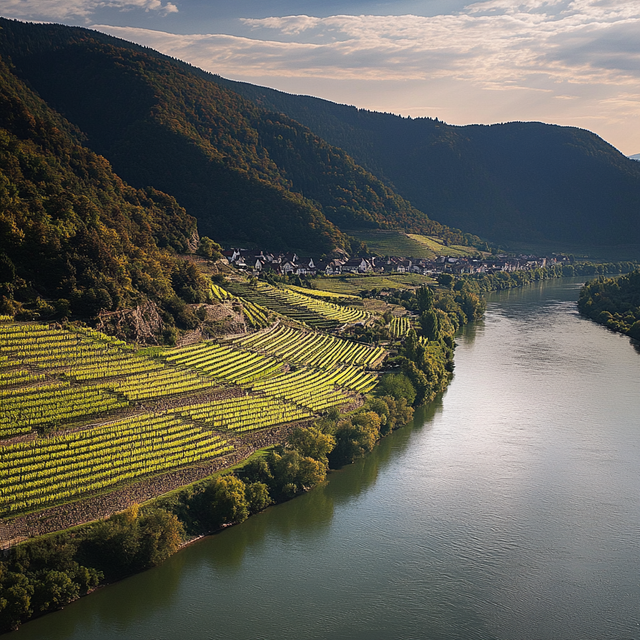
Elsarn sits so far up the Spitzer Graben that it belongs to the municipality of Mühldorf, not Spitz. The Spitzer Graben is the side valley that climbs west from the Danube at Spitz, and it is the coldest corner of the Wachau. Ried Brandstatt faces due south on very steep, narrow stone terraces at 440 to 480 meters, well above the valley floor. Bedrock and topsoil are both mica schist, thin and fast-draining, so the vines struggle and the berries stay small. Riesling from the Wachau at this altitude trades the stone-fruit richness of the riverside crus for tension, cut and a cool, stony edge.
The Wine
The Veyder-Malberg Riesling Elsarner Brandstatt 2022 is 100 percent Riesling, hand-harvested. The grapes macerate on their skins for up to 24 hours, with less time for riper lots, then press slowly over six to eight hours and settle in tank for a day. Fermentation starts on its own and peaks at 24°C. Low cellar temperatures block malolactic, which keeps the acidity sharp, and the wine rests six to eight months in old 300-liter oak barrels, then is filtered but not fined, with the first sulfur added at bottling. Expect lime and green apple, crushed slate, white flowers and a little fresh herb, then a taut, lean body that tastes of wet stone and a long, saline, citrus-pith finish. In 2022 a hot, dry July and early August gave way to a wet September, and late-October rain brought botrytis that cut Riesling yields in the western Wachau. The wines are lower in alcohol with good acidity.
The People
Peter Veyder-Malberg calls Brandstatt his recultivation project. When he founded his estate in Spitz in 2008, his plan was to take on old Wachau terraces that no machine can work and that older growers were giving up. Brandstatt was one of them. Its vines date to 1979, but the dry-stone walls had collapsed and the site had gone to neglect. He rebuilt the terraces in 2009 by hand and filled the gaps with cuttings from his own Buschenberg vines in Weissenkirchen. Every parcel he owns is worked by hand, and his bottles carry a small "Handarbeit" neck label to say so. The vineyards are farmed organically and without irrigation. Brandstatt is the clearest picture of what the estate exists to do: save a terrace that would otherwise have gone back to forest.
Food Pairing
Serve it cool, around 50 to 54 degrees, and give it some air. Pan-fried trout with brown butter, capers and parsley is the local match; the acidity cuts the butter while the stony finish meets the fish. Wiener schnitzel with a squeeze of lemon and a cucumber-dill salad works because the wine scrubs the fried crust clean. Thai green papaya salad with lime, fish sauce and peanuts takes on the citrus and salt directly. Try a goat cheese and leek tart, where the bright acid lifts the tang of the cheese. This is the bottle to open when you want to taste exactly where a wine comes from.
We ship wine to most states with a $100 minimum order for shipping. We don't ship spirits nor beer.
Weather shipping advisory: Orders placed during times of extreme heat or extreme cold will be held for no charge until more favorable weather returns.
The Wachau, widely considered Austria's premier wine region, is a breathtakingly beautiful valley along the Danube River, renowned for its powerful and dry expressions of both Grüner Veltliner and Riesling. These two grapes are the stars here, producing wines that are typically full-bodied and structured, yet always maintain a signature Austrian freshness. The Wachau is unique in its own ripeness scale to categorize its wines: Steinfeder, a rarely seen lighter style, Federspiel, representing a balanced ripeness with vibrant acidity, and Smaragd, indicating riper, more exotic fruit, sometimes with a touch of botrytis depending on the producer's style. This region, with its steep, terraced vineyards and unique microclimates, is home to a concentration of Austria's very best producers, crafting wines that are benchmarks for both Grüner Veltliner and Riesling globally.
Austria - Wachau

Riesling is a truly noble grape, known for its incredibly high acidity and a flavor profile that can range from bone dry to lusciously sweet. Germany is its heartland, and it's responsible for some of the world's most age-worthy examples, but Riesling also thrives in Austria, where it usually is dry. In Alsace, it takes on a slightly richer texture, while in parts of Australia, like the Clare and Eden Valleys, it displays a uniquely powerful and lime-tinged aromatic profile. This is a grape that has no problem showcasing its origins, and it's a fantastic example of how one variety can show many different expressions, each with its own unique appeal.