

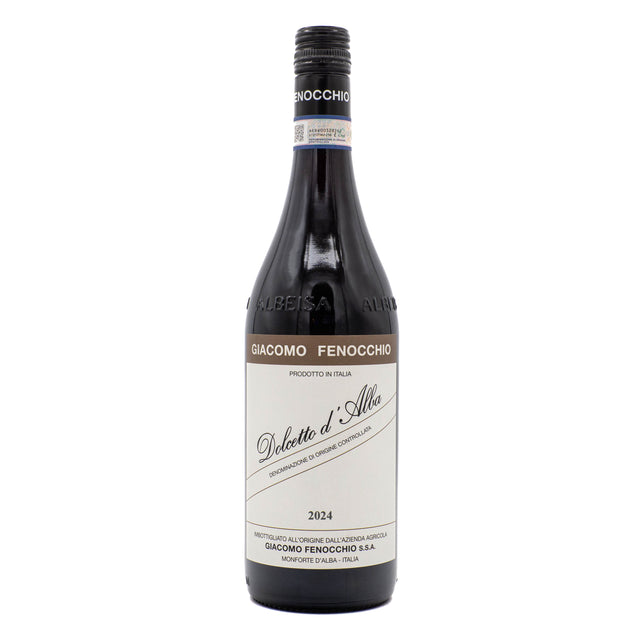
Giacomo Fenocchio Dolcetto d'Alba 2024
We have 6 in stock (Inventory is live and accurate)
The Land
There is a hectare inside Bussia planted to Dolcetto, and it belongs to the Fenocchio family. Bussia is one of Barolo's great crus, the zone Giacomo Fenocchio called the heart of the appellation, and virtually anyone else holding a hectare of it would have Nebbiolo in the ground. The parcel sits at 300 meters in Monforte d'Alba, directly in front of the cantina, on Helvetian soils of clay sediment, blue marl and tuff, the same geological package underneath the estate's Barolo. Claudio Fenocchio likes to point out from his terrace how small the Barolo zone really is: two hills to the left of his Bussia vineyard is Cannubi, the next hill to the right is Villero, and Bussia and Villero sit at essentially the same elevation, with Cannubi about twenty meters lower. The Dolcetto here does not get a lesser address. It gets exactly the same one.
The Wine
One hundred percent Dolcetto. Fermentation and maceration on the skins run about ten days, which is short by this cellar's standards and long by the standards of a grape most producers rush to bottle. Aging splits evenly: six months in stainless steel, then six months in the large Slavonian oak casks that are the only wood Claudio Fenocchio uses anywhere on the property. Production is roughly 750 cases. The 2024 season in the Langhe was wet and demanding, with spring rain and midsummer heat spikes squeezing the picking into narrow windows between weather systems; the region's wines came in around a degree to a degree and a half lower in alcohol than average, with the acidity that implies. None of that is a hardship for Dolcetto. Dark plum and black cherry, violets, and the faint bitter-almond note Dolcetto always leaves at the end, over low acid by Piedmontese standards and a chalky, gently drying tannin.
The People
Five generations of Fenocchios have farmed Monforte d'Alba since 1864, and for the first century of that the wine mostly went to neighbors. That changed in 1964, when Giacomo Fenocchio took the estate over with the stated ambition of making the finest wine in Barolo. He bought prime parcels in Cannubi and Castellero, but his conviction never moved off Bussia. When he died in April of 1989 his son Claudio inherited young, at precisely the moment Barolo was splitting into modernist and traditionalist camps and the modernists were the ones getting rich. Claudio did not follow. He kept the long fermentations on skins and aged only in large Slavonian casks; the estate still bottles a Bussia Riserva that spends ninety days on its skins. He now farms fourteen hectares across Barolo, Castiglione Falletto and Monforte, producing about 8,000 cases a year. Skurnik, the importer, lists the farming as sustainable.
Food Pairing
Dolcetto's low acid and soft drying tannin make it a fat-and-salt wine rather than an acid-and-tomato one. Start with tajarin in butter and sage, where the tannin does the cutting that acid would normally handle. Coarse Piedmontese salumi works on salt alone, which pushes the plum fruit forward. Bagna cauda, all anchovy and garlic and warm olive oil with raw vegetables to dredge through it, is the regional answer, and the wine's bitter-almond finish lines up with the garlic rather than arguing with it. A wedge of young Toma, still mild and buttery, will soften the tannin down to nothing. This is what Piedmont drinks on a weeknight while the Barolo waits in the cellar, and there is no shame whatsoever in doing the same.
We ship wine to most states with a $100 minimum order for shipping. We don't ship spirits nor beer.
Weather shipping advisory: Orders placed during times of extreme heat or extreme cold will be held for no charge until more favorable weather returns.
Piedmont, framed by the Alps in northwestern Italy, is a land of rolling hills and carefully cultivated vineyards. The continental climate, with its cold winters and warm summers, creates prime conditions for the Nebbiolo grape, which dominates much of the region's red wine production. The Langhe area is home to Barolo and Barbaresco, structured red wines known for their complex aromas, firm tannins, and aging potential. While Nebbiolo is the dominant grape of Piedmont, the region also makes interesting white wines like those from Arneis and Timorasso. Alto Piemonte is a separate region in the north with its own distinctive expressions of Nebbiolo, alongside other red grape varietals.
Italy - Piedmont

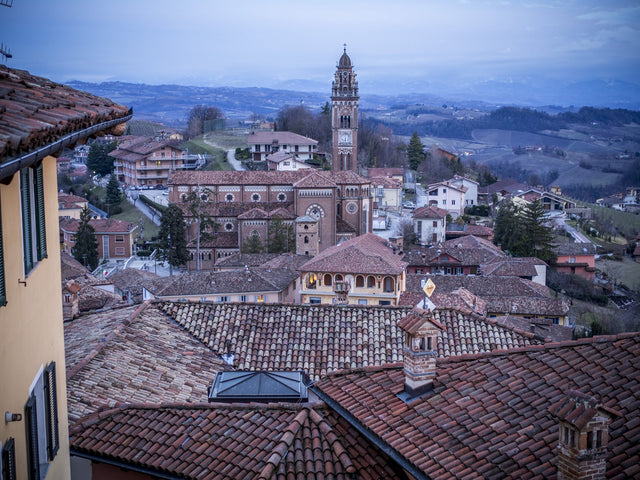
Dolcetto is a black grape variety native to the Piedmont region in northwest Italy, cherished for its ability to produce soft, fruit-forward red wines with relatively low acidity and a pleasing bitter finish. Known for its early ripening, Dolcetto yields wines that are typically deep in color, offering aromas of black cherry and licorice, making them highly approachable in their youth. The grape is most commonly associated with wines from Dogliani, Alba, and Asti, where the varietal's characteristics are celebrated in their purest form. While not as prestigious as Nebbiolo-based wines like Barolo and Barbaresco, Dolcetto holds a beloved place in Piedmontese wine culture for its straightforward, deliciously fruity profile and its versatility with food.