

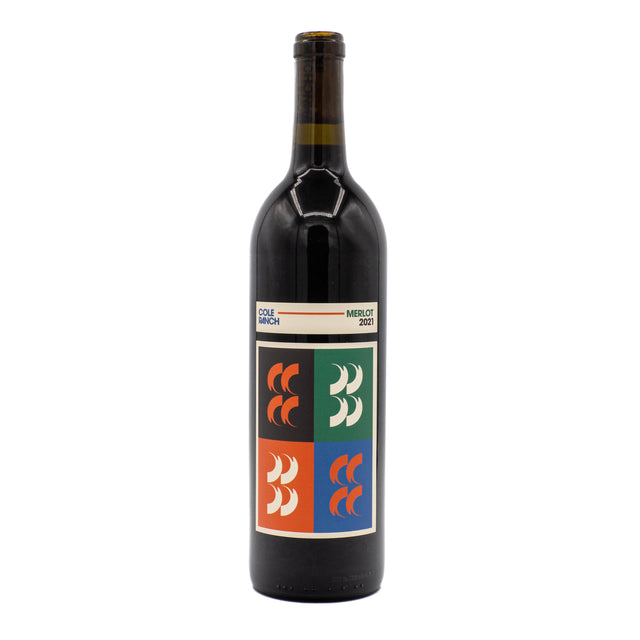
Rootdown Merlot Cole Ranch 2021
We have 22 in stock (Inventory is live and accurate)
The Land
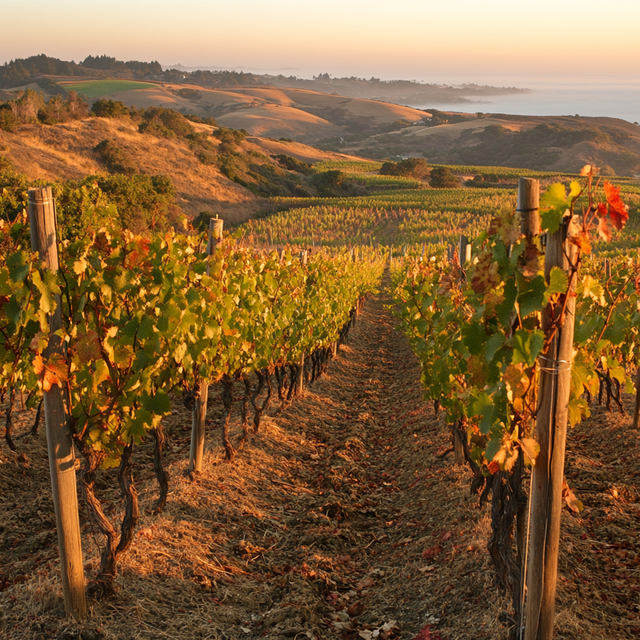
The smallest American Viticultural Area in the United States contains exactly one vineyard, and the nearest neighboring vines are a mile and a half away and 800 feet downhill. That is Cole Ranch, approved in 1983 as the country's thirtieth AVA, tucked into an unnamed mountain valley between Ukiah and the Anderson Valley in Mendocino County. The valley runs roughly a mile long and half a mile across at its widest, ringed by Coast Range hills climbing from 1,400 to 1,600 feet. These vines sit at about 1,450 feet, 25 miles from the Pacific. Soils run from deep gravelly clay loam to shallow gravelly silty clay; the federal soil survey named Cole Loam, Maxwell Variant Clay, Pinole Gravelly Loam and Bearwallow Loam. Rainfall averages 40 to 45 inches a year against roughly 32 in Ukiah below, and the site runs cooler than its neighbors at both ends of the growing season.
The Wine
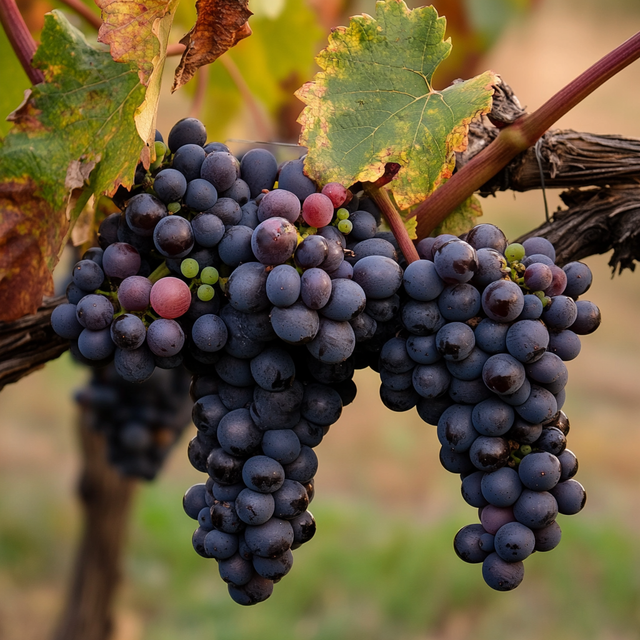
One hundred percent Merlot, picked October 14, 2021 at 22.6 brix, which is a long hang for a site this cool. The block is dry-farmed on St. George rootstock, part of the original 1973 planting of Riesling, Cabernet Sauvignon and Merlot. All of 1.8 tons came in. Fruit was fully destemmed and worked by pumpover, with malolactic finishing in neutral French oak; élevage was 100 percent neutral barrel with no additions. It landed at 13.5 percent alcohol, pH 3.56, total acidity 5.9 grams per liter, dry. Lucia reports 2021 as the surprise of the vineyard: clusters uniform, berries all one size, skins thickened by hangtime but neither bitter nor astringent. Statewide the drought year cut North Coast tonnage sharply and concentrated what survived. The glass gives bergamot and grapefruit peel over black cherry and red mulberry, then black tea, cocoa nib and pencil shavings, with firm tannin and genuinely high acid.
The People
Mike Lucia grew up in Healdsburg, took a viticulture degree from Fresno State, worked at Ridge, and became assistant winemaker at Copain in 2010, running the Tous Ensemble program until that winery sold. He started Rootdown in 2014 as a rosé project and widened it from there. In 2019 he acquired Cole Ranch, which means he did not buy a vineyard so much as an entire appellation. He farms it organically, works it with an electric tractor, and has grafted Jura varieties onto parts of the ranch, reasoning that the elevation, the cool nights and the gravelly soils have more in common with eastern France than with Napa. The 1973 Riesling, Cabernet and Merlot stayed. Of the last, Lucia is blunt: it thrives here, resists disease, and gives fruit worth taking seriously.
Food Pairing
Roast duck breast with a sour-cherry pan sauce: the firm tannin cuts the fat cap while the acidity runs alongside the cherry instead of fighting it. Braised short ribs with olives and orange peel, where the bergamot and grapefruit notes lock onto the citrus and the tannin finds protein to bind to. A mushroom and farro gratin with thyme, in which the black tea and cocoa-nib earthiness reads as seasoning rather than fruit. Or a wedge of well-aged Comté, whose crystalline salt pulls that high acid into balance. At 13.5 percent it never tires the table. This is the Merlot for the people who gave up on Merlot, and the bottle to open in front of someone certain they already know what the grape does.
We ship wine to most states with a $100 minimum order for shipping. We don't ship spirits nor beer.
Weather shipping advisory: Orders placed during times of extreme heat or extreme cold will be held for no charge until more favorable weather returns.
This region includes wines labeled "North Coast", which are often blends including Sonoma and Napa counties. This expansive area encompasses established regions like Mendocino and Lake Counties, as well as newer vineyard sites pushing towards the Oregon border. Mendocino County is known for its varied climates, from the Anderson Valley's cool, fog-influenced areas ideal for Pinot Noir and sparkling wine, to warmer inland spots. Lake County, further inland, offers volcanic soils and a warmer climate suitable for Cabernet Sauvignon and other varieties. Beyond these, even more northerly locations are being explored for their unique terroir, contributing to the evolving identity of California's northern wine production.
California - North Coast & Far North

Merlot, a red grape variety celebrated for its soft tannins and approachable fruit, is a cornerstone of winemaking around the world. It achieves some of its highest expressions on the Right Bank of Bordeaux, particularly in prestigious appellations like Pomerol and Saint-Émilion, where it forms the dominant part of many celebrated blends, contributing richness and plushness. Merlot also plays a significant role in Tuscany, where it is a key component in many Super Tuscan wines, and also stands alone to produce spectacular varietal wines. In Washington's Columbia Valley, Merlot thrives in the region's sunny days and cool nights, producing varietal wines that highlight its velvety texture and generous fruit profile. While Merlot is widely planted in California, some believe it reaches even greater heights in Washington State.
Merlot
Practicing Organic vineyard farming involves growing grapes using organic methods—avoiding synthetic fertilizers, herbicides, pesticides, and fungicides—but without formal certification. Wineries adopting this approach prioritize environmental health, soil vitality, and biodiversity, using natural practices such as composting, cover cropping, and manual pest control. Many small wineries opt for practicing organic methods rather than pursuing official organic certification, primarily due to the significant cost, paperwork, and time commitment involved in certification processes. As a result, practicing organic is a popular choice among boutique and artisanal producers who remain committed to sustainable agriculture while managing budgetary constraints.