

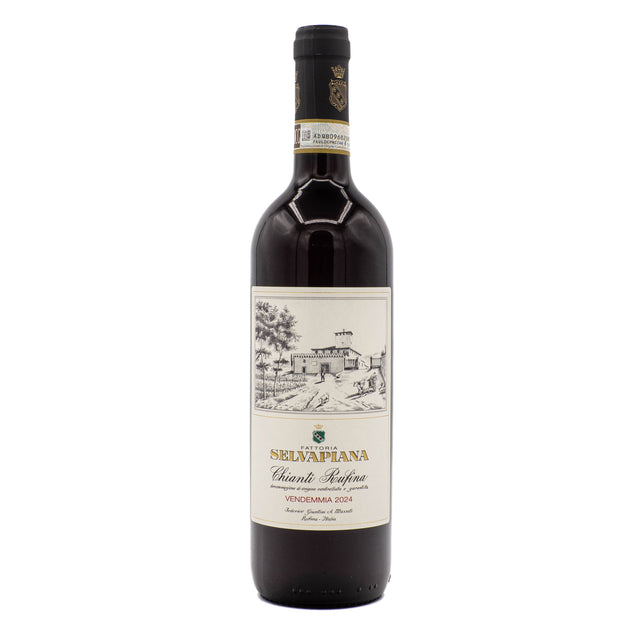
Selvapiana Chianti Rufina 2024
We have 3 in stock (Inventory is live and accurate)
The Land
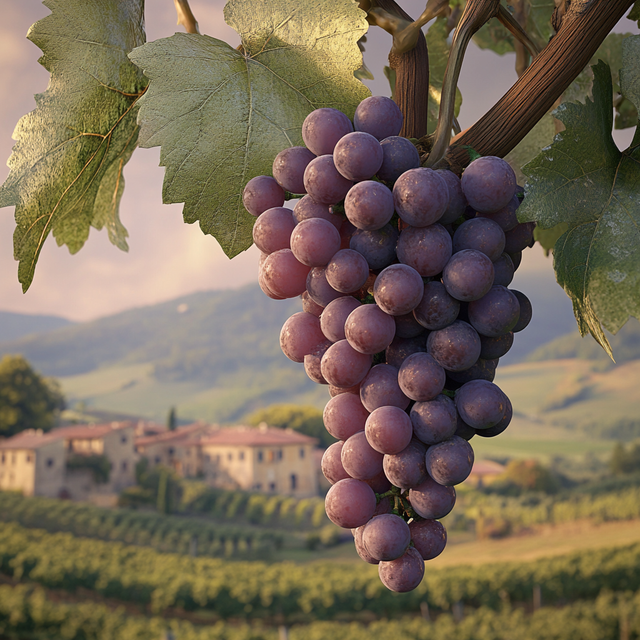
Before it made wine, Selvapiana was a lookout. The building at the heart of the estate began as one of the medieval watchtowers strung along the river Sieve to guard Florence's northeastern approach; the Renaissance enlarged it into a summer villa for Florentine nobles and for the bishops of Florence. The vineyards around it lie in Chianti Rufina, the smallest of the Chianti subzones at roughly 750 hectares, on slopes running up into the foothills of the Apennines. That nearness to the mountains is the point. Summers stay cooler here than farther south in Chianti and the swing between afternoon heat and night chill is wide, so Sangiovese ripens slowly across the whole season and holds its acid. Soils are the classic Tuscan pair, galestro and alberese, flaky schist over hard limestone. Rufina took its DOC in 1967 and DOCG in 1984, but Cosimo III de' Medici had already drawn part of its boundary in a proclamation of 1716.
The Wine
Ninety-five percent Sangiovese, the rest split among the traditional Rufina partners Canaiolo, Colorino and Malvasia Nera. Fruit comes from organically farmed parcels clustered around the villa, still carrying the names of the old sharecropping farms: Bucerchiale, Fornace, Casanova, Pesalova, Vigna al Pino. Fermentation is spontaneous, the estate having abandoned selected yeasts in 1992, and sulfur additions run well below what the cellar once used. Vinification happens in temperature-controlled stainless steel and in concrete casks carried over from the old cellar, with maceration lasting at least thirty days. Aging for this bottling leans on concrete, with smaller portions in steel and large foudre, so no oak flavor lands on the fruit. The 2024 season was long and largely dry: a rainy but cool spring kept mildew pressure low, veraison arrived early, and mid-August showers spared the vines real water stress. Federico Giuntini reported uniform ripening and healthy, thick-skinned grapes. Sour cherry, dried orange peel, tobacco leaf and iron, on fine-grained tannin and a spine of acid.
The People
Michele Giuntini, a Florentine banker, bought Selvapiana in 1827, and the family has held it since. His descendant Francesco Giuntini ran the estate from 1957 to 1997 and spent those four decades arguing that Rufina deserved a name of its own. He was among the first Tuscan producers to make his Riserva entirely from Sangiovese, and in 1979 he bottled the Bucerchiale parcel separately, a single-vineyard Chianti at a moment when almost nobody was making one. In 1978 he hired a young Franco Bernabei as consulting enologist; Bernabei still advises the estate. Since 1997 the property has been run by Federico and Silvia, adopted children of Francesco and children of Franco Masseti, who managed Selvapiana from 1953 to 1990. The estate covers 250 hectares, of which 58 are vines, 36 olive groves and 140 woodland, and it is certified organic, a conversion that began with the Fornace vineyard in 1990.
Food Pairing
Pour it with bistecca alla fiorentina, where the tannin cuts rendered fat and the acid resets the palate between bites of char. It works equally with pappa al pomodoro, the acid in the wine meeting the acid in the tomato as an equal rather than an opponent. Ribollita thick with cavolo nero and white beans gives the wine something earthy to lean into. And with a plate of prosciutto and pecorino toscano, the salt sharpens the red fruit while the tannin scrubs fat off the cheese. This is a weeknight bottle in the best sense, the Chianti you open on Tuesday because it costs less than the pasta it is standing next to, and then go looking for again on Wednesday.
We ship wine to most states with a $100 minimum order for shipping. We don't ship spirits nor beer.
Weather shipping advisory: Orders placed during times of extreme heat or extreme cold will be held for no charge until more favorable weather returns.
Tuscany is one of Italy’s most iconic wine regions, anchored by historic regions like Chianti and Montalcino, where Sangiovese thrives in clay-limestone soils and varying elevations. Chianti Classico produces medium-bodied, savory reds, while Montalcino’s warmer, drier conditions give rise to the powerful and long-lived Brunello. Along the Tuscan coast, regions like Bolgheri emerged in the late 20th century with the rise of Super Tuscans—often blends of international varieties like Cabernet Sauvignon and Merlot grown in marine-influenced soils. While overwhelmingly known for red wines, Tuscany is also home to great classic whites grown in San Gimignano and modern whites often made with French grape varieties.
Italy - Tuscany

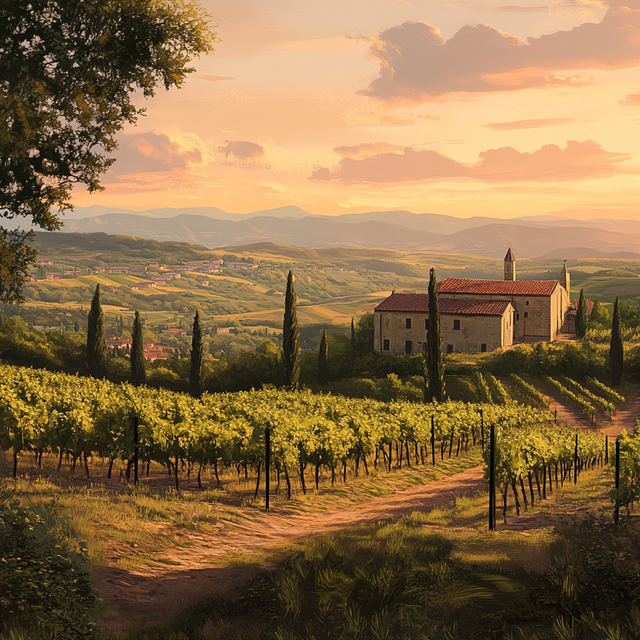
Sangiovese is Italy’s most widely planted red grape and the backbone of many of the country’s most renowned wines, including Chianti Classico, Brunello di Montalcino, and Vino Nobile di Montepulciano. Its name likely derives from the Latin “sanguis Jovis,” or “blood of Jupiter,” hinting at its ancient Roman roots. While native to central Italy, particularly Tuscany, it is also grown in regions like Umbria, Emilia-Romagna, and even scattered sites abroad. Sangiovese is known for its high acidity, firm tannins, and bright red fruit character, often showing notes of sour cherry, dried herbs, and earthy spice. Its structure and versatility make it a natural match for food and a compelling lens through which to explore regional terroirs.
Sangiovese
Certified Organic farming is an agricultural practice where vineyards adhere to strict regulations prohibiting the use of synthetic pesticides, herbicides, fungicides, and fertilizers. Instead, certified organic growers rely on natural alternatives, including compost, cover crops, and beneficial insects, to nourish the soil and manage pests. Certification requires compliance with established organic standards, typically verified by third-party agencies such as USDA Organic in the United States or EU Organic in Europe. This method emphasizes ecological balance, biodiversity, and sustainability, aiming to produce high-quality grapes and wines while reducing environmental impact and promoting long-term vineyard health. Organic farming is not allowed to use Glyphosate.