

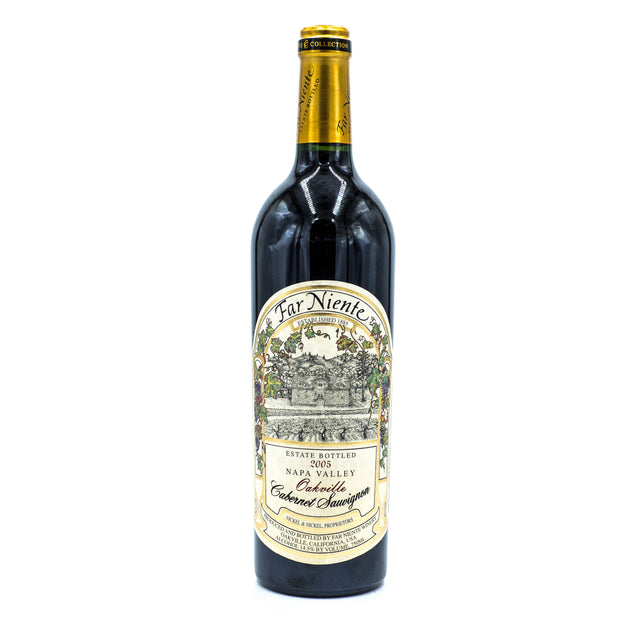
Far Niente Cabernet Sauvignon 2018
We have 3 in stock (Inventory is live and accurate)
Summer Shipping Advisory: Orders may be temporarily held during periods of extreme heat to ensure wine arrives in optimal condition.
View current shipping weather map →
The Land
The Martin Stelling Vineyard has Harlan Estate on one flank and Martha's Vineyard on the other, and it sits on an alluvial fan entirely its own, which is rare even on the western Oakville bench where fans off the Mayacamas usually overlap and blur together. The site runs 52.2 acres across three sloping blocks, worked into gravel and clay deposits laid down by that same drainage. Oakville is Napa's narrow middle, pulled cool by morning fog moving up from San Pablo Bay and then warmed hard through the afternoon. In 2018 these blocks were clone 7 Cabernet Sauvignon on 5C rootstock, planted in east-west rows; the estate began a strategic replant in 2021 that changed both the plant material and the row orientation, so this bottling belongs to the older configuration. The Malbec and Petit Verdot came from Airshow Vineyard on Oakville Cross Road, with a further contribution from Sullenger.
The Wine
Ninety-one percent Cabernet Sauvignon, 6 percent Petit Verdot and 3 percent Malbec, the fruit drawn mostly from Stelling. Twenty months in French oak, 70 percent of it new, aged in caves Gil Nickel started excavating in the early 1980s: the first modern wine caves built in North America since the turn of the century, since expanded to 40,000 square feet and stocked with nothing but French barrels. It bottled at 14.5 percent alcohol. 2018 is the Napa vintage growers still cite for its patience. A dry winter and mild spring pushed bud break late, flowering and set went almost too well and left a crop 20 to 30 percent above normal, and then the summer simply behaved. No heat spikes, no scramble. Picking stretched from early September into late October, punctuated by nearly an inch of rain on October 2 and hot dry winds mid-month. The wine shows cedar and sage over cassis, black cherry and currant, with pencil shaving and cocoa woven into the tannin.
The People
John Benson, a forty-niner turned real estate investor and uncle to the painter Winslow Homer, built the stone winery on a wooded knoll in 1885, hiring Hamden McIntyre, the architect behind what is now the Culinary Institute at Greystone, to design one of Napa's first gravity-flow cellars. Prohibition shut it in 1919 and the building sat empty for sixty years while the land around it went to cherry orchards and then to Martin Stelling Jr., who assembled 5,000 Oakville acres before dying in a car crash in 1950. In 1979 Gil Nickel, an Oklahoma nurseryman then studying winemaking at UC Davis, found the winery abandoned, persuaded Doug Stelling to sell, and spent three years on a restoration that put it on the National Register of Historic Places. The first crush in the rebuilt cellar was 1982. Nicole Marchesi joined as enologist in 2005 and in 2009 became only the fourth winemaker in the estate's modern history. All estate vineyards are Certified California Sustainable.
Food Pairing
A dry-aged ribeye, crusted hard and rested properly: the tannin needs that much protein and rendered fat to soften against, and the char meets the new-oak toast on even terms. Rack of lamb with rosemary and garlic, where the cedar and sage in the glass track the herb rather than fight it. Roasted bone marrow on grilled bread with a sharp parsley salad, because the marrow coats the palate, the tannin scrapes it clean, and the parsley resets everything for the next bite. Or a wedge of five-year cheddar, whose salt and butterfat blunt the edges of the oak. At 14.5 percent this asks for food with real weight behind it. Decant it an hour ahead. This is the bottle for a table that has cleared its whole evening.
We ship wine to most states with a $100 minimum order for shipping. We don't ship spirits nor beer.
Weather shipping advisory: Orders placed during times of extreme heat or extreme cold will be held for no charge until more favorable weather returns.
Napa Valley, a narrow strip of land in Northern California, is one of the world's most renowned wine regions. Its history dates back to the mid-19th century, but its rise to international prominence began in the latter half of the 20th century, particularly after the famous 1976 "Judgment of Paris" tasting, where Napa wines triumphed over French counterparts. Geographically, the valley is roughly 30 miles long and a few miles wide, running north-south, bordered by the Mayacamas Mountains to the west and the Vaca Range to the east. The climate varies significantly from south to north: the southern end, near San Pablo Bay and including the Carneros region, is cooler, influenced by fog and breezes, while the northern end, near Calistoga, experiences much warmer temperatures. This gradient, along with the distinction between the fertile valley floor and the rugged mountain vineyards, contributes to a diversity of growing conditions, allowing for a wide range of grape varieties, though Cabernet Sauvignon reigns supreme.
California - Napa Valley

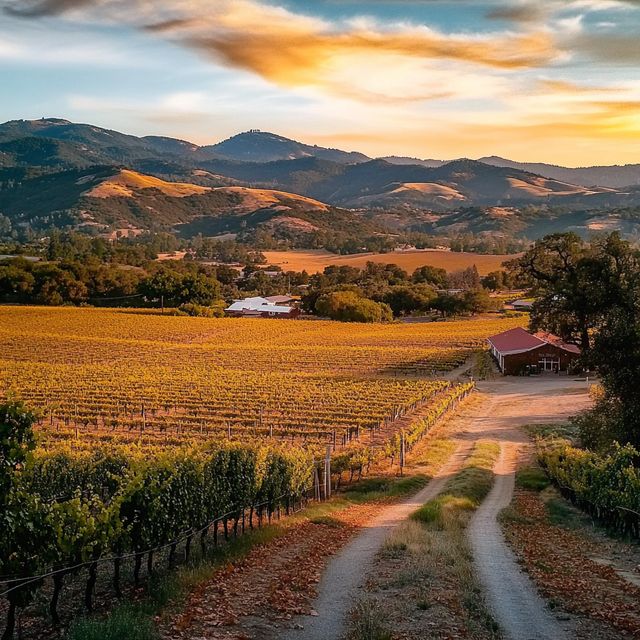
Cabernet Sauvignon, originally hailing from Bordeaux, France, has triumphantly spread to become a cornerstone of vineyards worldwide, achieving particular renown in Napa Valley. This versatile grape variety adapts to a broad spectrum of climates, producing full-bodied wines that are rich in black cherry and blackcurrant flavors, with layered complexities of oak and spice. The grape's success in regions like Napa Valley is a testament to its global adaptability, where it benefits from the optimal blend of warm days and cool nights, coupled with diverse soil types, to express a unique balance of power and elegance that pays homage to its Bordeaux origins.