

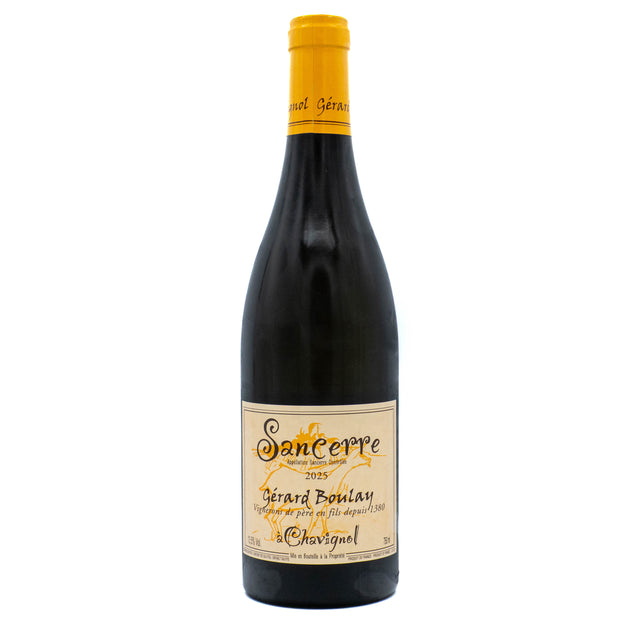
Gérard Boulay Sancerre Chavignol 2025
We have 5 in stock (Inventory is live and accurate)
The Land
The steep white slopes above Chavignol are Kimmeridgian marl, the same Upper Jurassic, oyster-fossil-rich stage that underlies Chablis roughly 100 kilometers to the southeast. Both sit on the rim of the Paris Basin. Locals call the soil terres blanches because it whitens as it dries, and it runs about 70 percent clay to 30 percent limestone: cold, damp, slow to warm, which stretches ripening and builds structure instead of perfume. That is the geological reason the most serious Sancerre comes off this one hamlet rather than the caillottes limestone around the town or the flint beds down by the Loire. Boulay holds nine hectares in Chavignol, eight of them on terres blanches, worked by hand because the gradients allow nothing else. The family appears in Chavignol land records in 1380, five centuries before Sancerre gave up red wine for white.
The Wine
Sauvignon Blanc. This is the Chavignol bottling, a blend of Boulay's younger-vine parcels on the Kimmeridgian slopes of the village, and deliberately not one of his single-parcel wines from Monts Damnés, Clos de Beaujeu, La Côte or Comtesse. It is also the one cuvée raised entirely in tank rather than a mix of foudre and used 300-liter barrels, which keeps it direct and unpadded. Fermentation runs on the vineyard's own yeasts; Boulay adds none, and uses little to no sulfur. Grapefruit pith, white currant, crushed shell and chalk dust, with more weight through the middle than caillottes Sancerre delivers and a cold, stony finish. 2025 was early and unusually clean: budbreak on April 7, about ten days ahead of the decade average, the driest May and June in over fifteen years, almost no mildew. Sauvignon picking began August 28.
The People
Gérard Boulay has farmed organically since 1990, which in Sancerre in 1990 was close to eccentric. He harvests everything by hand and plants nothing casually; the youngest vines at the domaine went into the ground in 1972. In the cellar he adds no yeast, little to no sulfur, and describes his own role as surveillance, making sure nothing goes wrong. He works au feeling. His line is c'est la nature qui fait le vin. His neighbors in Chavignol are the Cotat brothers and Vatan, so the village is small and the standard is punishing. Boulay's top wines age twenty years without difficulty, and the domaine's reputation rests on longevity rather than the aromatic fireworks most Sancerre is sold on. This is as clear a demonstration of Kimmeridgian marl in a glass of Sauvignon Blanc as exists anywhere.
Food Pairing
Chavignol's other export is Crottin de Chavignol, so goat cheese here is not a cliché but a closed loop: the same hillside made both. Beyond that, a whole roasted branzino with lemon and olive oil. Asparagus with a soft-boiled egg and brown butter, where Sauvignon's green edge stops fighting the vegetable and starts agreeing with it. Or scallops seared hard with capers, which the wine's salinity and weight can actually meet. Give it an hour open. This is the Sancerre for people who thought they were done with Sancerre.
We ship wine to most states with a $100 minimum order for shipping. We don't ship spirits nor beer.
Weather shipping advisory: Orders placed during times of extreme heat or extreme cold will be held for no charge until more favorable weather returns.
The Loire Valley, often referred to as the "Garden of France," is a revered wine region that stretches along the Loire River, producing an array of distinct wines, including the crisp, sea-breeze influenced Muscadet near the Atlantic coast, the versatile and expressive Chenin Blanc in regions like Vouvray and Anjou, the elegantly fragrant Cabernet Franc from Chinon and Bourgueil, and the minerally complex Sauvignon Blanc-based Sancerre and Pouilly-Fumé from its eastern vineyards. This is a reflection of the valley's varied terroir and climate, which together foster the creation of wines that are celebrated for their finesse, diversity, and food-friendliness.
Loire Valley

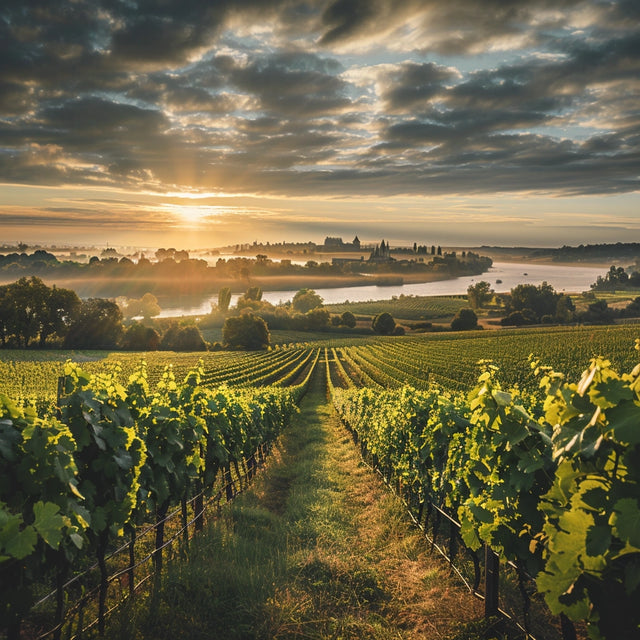
Sauvignon Blanc, a white grape of significant character, is believed to have originated in the Loire Valley of France, where it continues to produce some of the world’s most iconic and expressive examples. This variety has also found success in Bordeaux, where it is often blended with Sémillon, as well as in New Zealand, where it has become a signature grape, and many other regions across the globe. Known for its vibrant acidity and distinctive aromatic profile, Sauvignon Blanc often displays a pronounced greenness, with notes of fresh-cut grass, herbaceousness, and sometimes even a touch of jalapeño, depending on ripeness and region. These traits are often supported by citrus fruits like grapefruit and lime, leading to wines that are both refreshing and complex, ranging from steely and mineral-driven to more tropical and fruit-forward styles.