

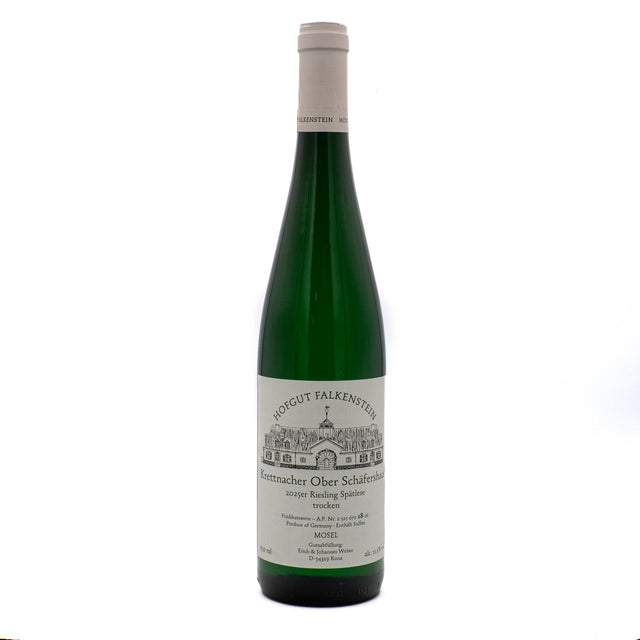
Hofgut Falkenstein Krettnacher Ober Schäfershaus Riesling Spätlese Trocken 2025
We have 8 in stock (Inventory is live and accurate)
Summer Shipping Advisory: Orders may be temporarily held during periods of extreme heat to ensure wine arrives in optimal condition.
View current shipping weather map →
The Land
Ober Schäfershaus does not appear on most maps of the Saar, because it is not one of the registered vineyard sites. It is an old place-name, a Gewann, inside today's Krettnacher Altenberg. Before the 1971 Wine Law this western flank of the hill was sold under the name Silberberg, which vanished when German sites were consolidated. What makes it distinct is the rock. The slope is quartz-rich, gray-clayey slate, but a vein of diabase, a dark volcanic stone, runs through the steeper and warmer front end in Ober Schäfershaus and its neighbors Ober Schodenhaus and Auf dem Hölzchen. Hofgut Falkenstein farms about 0.5 hectares of old vines in the middle of the parcel. That extra warmth is why this is the site the Webers push to dry Spätlese ripeness.
The Wine
The Hofgut Falkenstein Krettnacher Ober Schäfershaus Riesling Spätlese Trocken 2025 is bottled from a single Fuder named Lorenz Manni, AP 18. The Webers press whole bunches gently for two to three hours, let gravity move the juice, and ferment spontaneously in old oak with no temperature control. The wine is bottled straight off its lees without pumping, racking or filtering. Spätlese ripeness taken fully dry gives this cuvée more body than the estate's Kabinetts, and the diabase shows up as a savory, stony grip. In 2025 it opens with lychee, yellow fruit and fresh herbs, then turns minty and chalky, with a tight, precise finish. The Saar's 2025 harvest was early and fast, with the picking window for dry wines lasting less than three weeks.
The People
Erich Weber grew up in Krettnach, and he says the local growers have always treated Ober Schäfershaus as the best site in the village. When the Webers labeled this plot, they chose the old field name over the broader Altenberg for that reason. Johannes Weber has gone as far as questioning elderly Krettnach residents about the hill's history. That instinct runs through the whole estate. Each cask carries a nickname, usually for the family that once owned the parcel it holds, and each is bottled separately with its own AP number, a traditional practice that almost no one keeps up anymore. Nothing is added to correct the wine: no cultured yeast, no enzymes, no fining. The point is to let each parcel speak without correction.
Food Pairing
A dry Spätlese from the Saar has the weight to stand in for white Burgundy at the table. Roast a chicken with tarragon butter under the skin and deglaze the pan with a splash of the wine. Sear scallops hard in brown butter and serve them over a celery root purée. In spring, white asparagus with hollandaise and boiled new potatoes is the classic German match, and the acidity keeps the sauce from feeling heavy. Veal schnitzel pounded thin, fried in clarified butter and finished with lemon and capers works just as well. This is the Riesling to pour for the friend who swears they only drink dry white wine.
We ship wine to most states with a $100 minimum order for shipping. We don't ship spirits nor beer.
Weather shipping advisory: Orders placed during times of extreme heat or extreme cold will be held for no charge until more favorable weather returns.
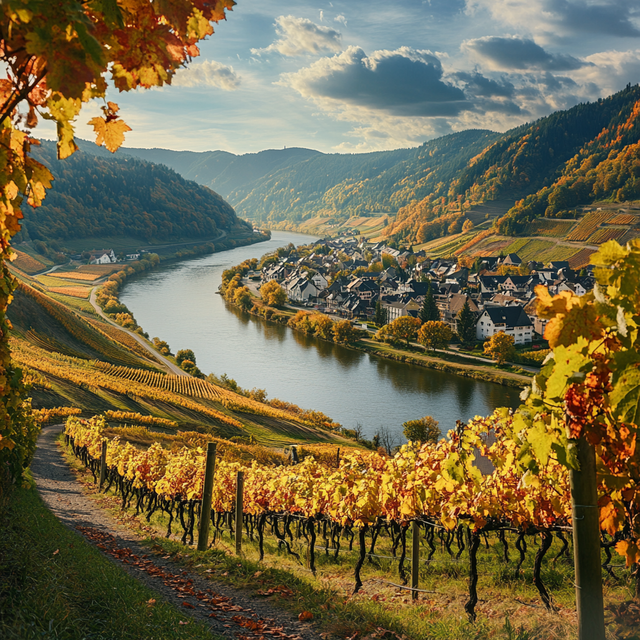
The Mosel, a stunning river valley in Germany, is a region synonymous with Riesling. The area's steep, slate slopes create a unique terroir that imparts a distinct minerality and high acidity to the wines. Mosel Rieslings range from bone dry to intensely sweet, showcasing the grape's versatility and the region's incredible potential for producing complex, age-worthy wines. The wines of the Mosel are known for their aromatic complexity and their incredibly graceful nature, and are a benchmark for all Riesling made throughout the world.
Germany - Mosel

Riesling is a truly noble grape, known for its incredibly high acidity and a flavor profile that can range from bone dry to lusciously sweet. Germany is its heartland, and it's responsible for some of the world's most age-worthy examples, but Riesling also thrives in Austria, where it usually is dry. In Alsace, it takes on a slightly richer texture, while in parts of Australia, like the Clare and Eden Valleys, it displays a uniquely powerful and lime-tinged aromatic profile. This is a grape that has no problem showcasing its origins, and it's a fantastic example of how one variety can show many different expressions, each with its own unique appeal.