

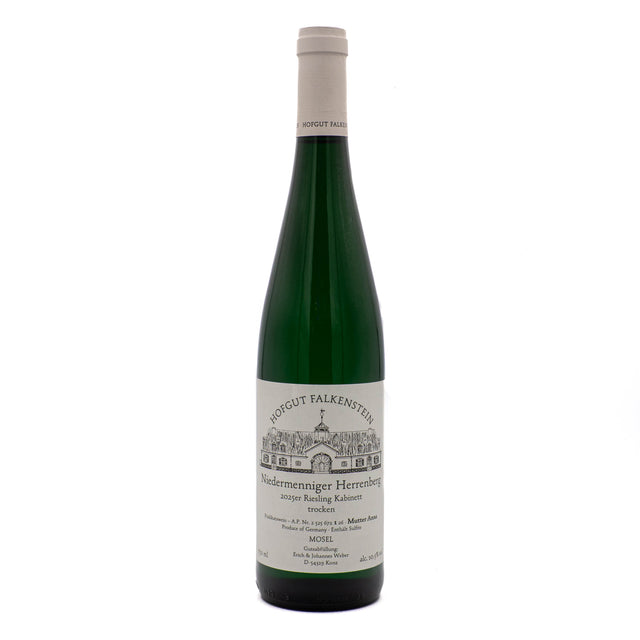
Hofgut Falkenstein Niedermenniger Herrenberg Riesling Kabinett Trocken 2025
We have 8 in stock (Inventory is live and accurate)
Summer Shipping Advisory: Orders may be temporarily held during periods of extreme heat to ensure wine arrives in optimal condition.
View current shipping weather map →
The Land
Niedermennig is the village Hofgut Falkenstein calls home, and the Herrenberg is the south-facing hill that rises above it in the Konzer Tälchen, a small side valley east of the Saar. The slope was historically split in two, Herrenberg on the western half and Zuckerberg on the eastern, and old survey maps show vines only on the lower and middle slope. Planting pushed higher up the hill around 1900. The soil is iron-rich, gray-clayey slate. In the Saar, one of the coldest corners of German wine, a south-facing slate slope is what gets Riesling ripe at all, yet the Tälchen stays cool enough that the Webers can pick at Kabinett weight and still have a wine with real flavor. That tension is the whole point of a dry Saar Kabinett.
The Wine
The Hofgut Falkenstein Niedermenniger Herrenberg Riesling Kabinett Trocken 2025 is AP 1, the cask the Webers call Mutter Anna. The fruit was picked early from mature vines, pressed as whole bunches over two to three hours, and fermented spontaneously in an old 1,000-liter Fuder with no cultured yeast, no chaptalization and no deacidification. It goes to bottle directly off its gross lees without racking or filtering, which gives a light dry Riesling more texture than its alcohol would suggest. Mirabelle, wild strawberry, pear and bergamot, with herbs, smoke and fine spice behind. The palate is laser-like and razor-sharp, finishing on juicy fresh herbs. The 2025 Saar harvest began unusually early and was completed fast; cool nights kept the fruit clean. Give it a year or two and the tart edge on the finish softens.
The People
Hofgut Falkenstein is Erich Weber and his son Johannes, working as a two-generation team out of Konz-Niedermennig. Their cellar is defined as much by what they leave out as what they do. There is no temperature control on fermentation, no cultured yeast, no enzymes and no fining agents. Juice moves by gravity into old oak Fuder and a couple of 500-liter Halbfuder, and each cask is bottled on its own, straight off the lees, with no pumping, racking or filtration beforehand. Every bottle carries the cask's AP number and nickname, so a Falkenstein label tells you not just the vineyard but the exact barrel. The dry Kabinett is the estate's calling card: light, dry-tasting Saar Riesling that relies on ripe acidity rather than sugar for its balance.
Food Pairing
A dry Riesling from the Saar this sharp belongs with seafood and salt. Shuck a dozen oysters and serve them with a shallot mignonette. Order in good sashimi, especially yellowtail and scallop, and skip the heavy soy. Fry calamari in a light rice-flour batter and hit it with lemon and flaky salt, the acidity scrubbing the palate clean between bites. A salad of fresh goat cheese, shaved fennel, radish and toasted hazelnuts in a lemon vinaigrette matches the wine's herbal side. This is the bottle to keep cold in the door of the fridge for any night when dinner is simple and you want it to taste like more.
We ship wine to most states with a $100 minimum order for shipping. We don't ship spirits nor beer.
Weather shipping advisory: Orders placed during times of extreme heat or extreme cold will be held for no charge until more favorable weather returns.
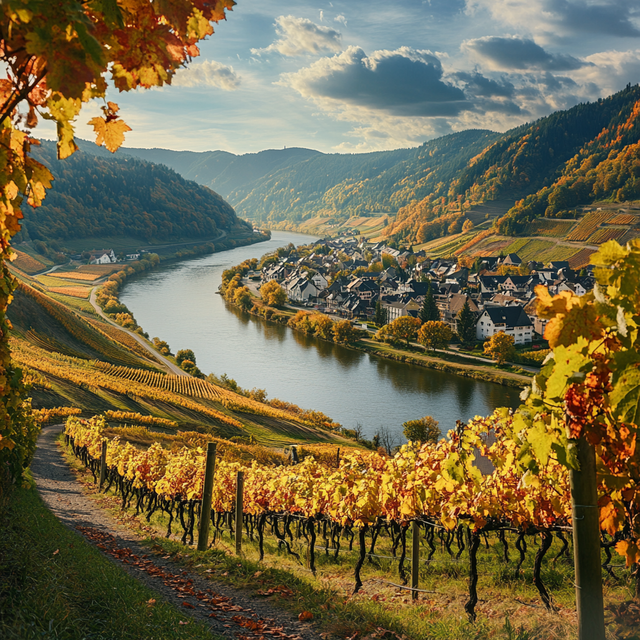
The Mosel, a stunning river valley in Germany, is a region synonymous with Riesling. The area's steep, slate slopes create a unique terroir that imparts a distinct minerality and high acidity to the wines. Mosel Rieslings range from bone dry to intensely sweet, showcasing the grape's versatility and the region's incredible potential for producing complex, age-worthy wines. The wines of the Mosel are known for their aromatic complexity and their incredibly graceful nature, and are a benchmark for all Riesling made throughout the world.
Germany - Mosel

Riesling is a truly noble grape, known for its incredibly high acidity and a flavor profile that can range from bone dry to lusciously sweet. Germany is its heartland, and it's responsible for some of the world's most age-worthy examples, but Riesling also thrives in Austria, where it usually is dry. In Alsace, it takes on a slightly richer texture, while in parts of Australia, like the Clare and Eden Valleys, it displays a uniquely powerful and lime-tinged aromatic profile. This is a grape that has no problem showcasing its origins, and it's a fantastic example of how one variety can show many different expressions, each with its own unique appeal.