

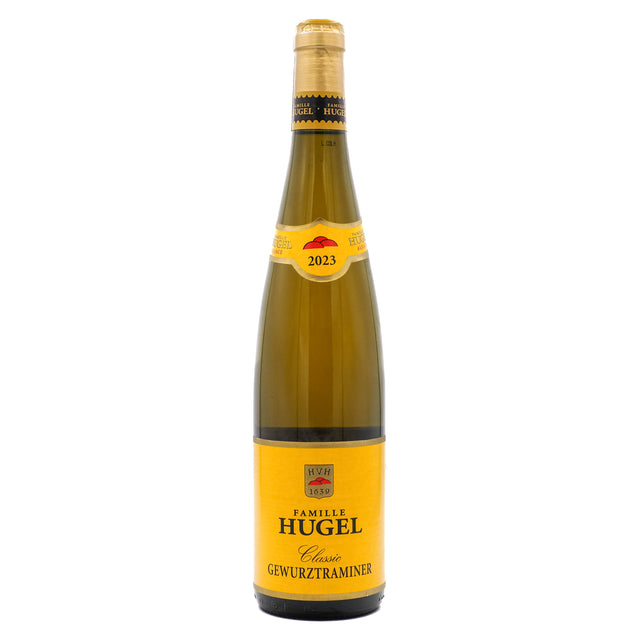
Hugel Gewurztraminer 2023
We have 2 in stock (Inventory is live and accurate)
Summer Shipping Advisory: Orders may be temporarily held during periods of extreme heat to ensure wine arrives in optimal condition.
View current shipping weather map →
The Land
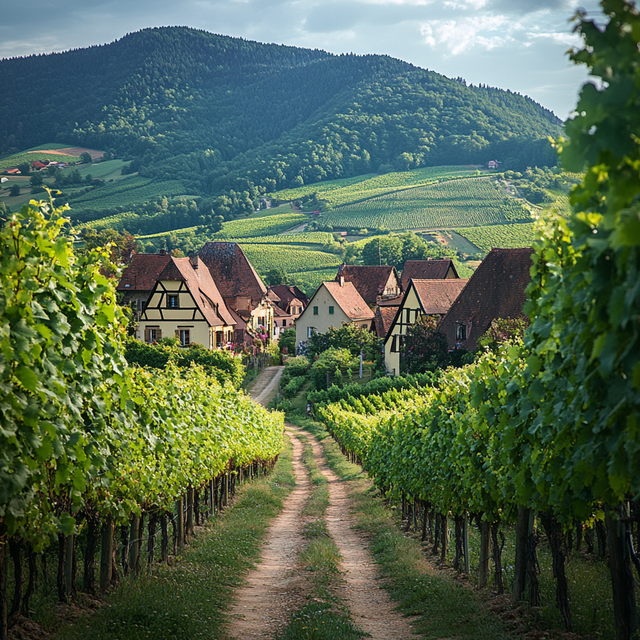
Alsace sits in the rain shadow of the Vosges, and the effect is not subtle. Colmar, twenty kilometers from a crest that tops out at 1,424 meters, gets roughly a quarter of the precipitation that falls on the ridge above it, somewhere between 500 and 600 mm a year, which makes this one of the driest wine regions in France. The climate is semi-continental: cold winters, hot dry summers, a long slow ripening season. Hugel's home is Riquewihr, and the Classic bottling draws on a dozen favored sites in and around the village, planted on clay and limestone. Riquewihr's two grand crus, Schoenenbourg and Sporen, run from 265 to 380 meters, and Sporen's heavy Jurassic clay-marl is the Gewurztraminer ground here.
The Wine
100% Gewurztraminer from vines averaging 46 years, hand-harvested on 18 September 2023 at 49 hectoliters per hectare. Fruit goes to the press in small tubs and fills by gravity with no pumping; fermentation runs at 18 to 24 degrees Celsius, the wine is racked once, clarifies naturally over the winter, and is bottled the following spring under DIAM. It finishes at 14.24% alcohol with 13.1 g/L residual sugar against 5.16 g/L tartaric acidity, which reads as barely off-dry rather than sweet. Rose and jasmine first, then peach and mirabelle, then lychee, mango, dragon fruit. 2023 was a drought year in Alsace: almost no rain between 18 April and 23 July, immaculate fruit health as a result, and yields cut hard, Riesling worst of all.
The People
The Hugels arrived in Riquewihr in 1639, when Hans Ulrich Hugel came south from Switzerland during the Thirty Years' War. Twelve generations later the family still works from the house on the main square it moved into in 1902, farming 30 hectares of its own, more than half grand cru, and contracting roughly 110 more. Jean "Johnny" Hugel spent three years walking the region with a geologist to help draw the grand cru boundaries, then drafted the late-harvest regulations that became French law in 1984 and are still called Hugel's Law. He also declined to put the words Grand Cru on his own labels, judging the classification too generous. The family's own vineyards were certified organic in 2025, after this harvest; the Classic leans on contracted growers, so read that certification as direction of travel rather than a claim about this bottle.
Food Pairing
Hugel points this at spicy Asian cooking, smoked salmon, and strong cheese, and all three land. A Thai green curry heavy on lemongrass and ginger, smoked salmon with creme fraiche and dill on dark rye, a ripe washed-rind Munster eaten the Alsatian way with caraway seeds, or pork belly braised slowly with apples and onions. Gewurztraminer's weight and low acidity mean it does not fight chili heat the way a taut Riesling does; the trace of sugar absorbs it instead. This is the bottle for the night when takeout beats whatever you were planning to cook.
We ship wine to most states with a $100 minimum order for shipping. We don't ship spirits nor beer.
Weather shipping advisory: Orders placed during times of extreme heat or extreme cold will be held for no charge until more favorable weather returns.
The Alsace wine region is located in northeastern France and is known for producing aromatic white wines. The region benefits from a cool climate with a combination of continental and maritime influences, allowing for the cultivation of grape varieties like Riesling, Gewürztraminer, and Pinot Gris. Pinot Noir has also been making major strides in this border region.