

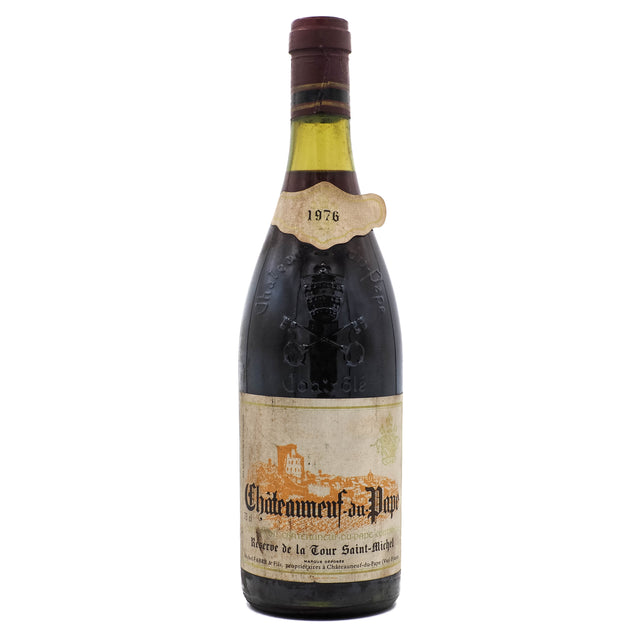
Reserve de la Tour Saint-Michel Chateauneuf-du-Pape 1976
We have 0 in stock (Inventory is live and accurate)
The Land
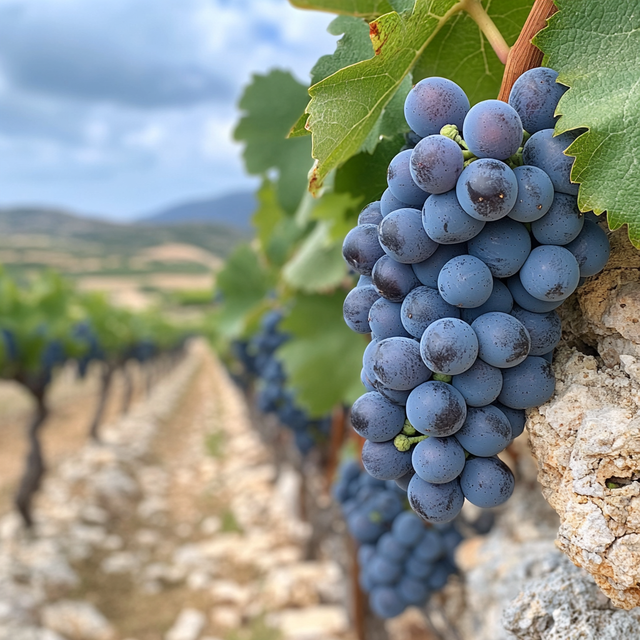
Châteauneuf-du-Pape is not one soil but several. The postcard image, fields of fist-sized quartzite galets roulés, covers only part of the appellation; the rest runs to sand, safres sandstone, and clay-limestone. The galets earn their reputation anyway. Dropped by the Alpine Rhône over millennia, they hold daytime heat and give it back overnight, and they force roots deep in a place with little summer rain and a great deal of mistral. The vineyards sit on terraces between Orange and Avignon, and in 1936 this became the first AOC in France, its rules built from a growers' charter drafted in 1923 at Château Fortia. Thirteen varieties are permitted, eighteen if you count the color mutations separately, though Grenache has always done most of the work.
The Wine
Fifty years on, this is not the wine it was on release, and it should not be bought as though it were. 1976 was a drought year across France: historic heat, real water stress, small crops. In the southern Rhône that made Châteauneuf of weight and warmth rather than tension, and the best have held. What a bottle shows now is tertiary rather than fruity — dried fig, prune, orange peel, dried lavender and thyme, leather, forest floor, a truffled edge. Tannin resolved long ago, the color is translucent brick going amber at the rim, and the texture reads closer to old Burgundy than to modern Châteauneuf. No blend is documented for this bottling; Grenache-dominant is the reasonable assumption for the vintage, not a verified fact. Stand it upright two days ahead, pull the cork slowly because it will want to crumble, decant off the sediment, and serve cool. Some share of any fifty-year-old bottle disappoints. That is the trade you are making.
The People
Here we owe you plain speech. Trade records show a 1976 Châteauneuf-du-Pape under the Tour Saint-Michel name, and Domaine Tour Saint Michel is a real estate, founded in 1930 by Michel Fabre and run today by his granddaughter Mireille Porte, the third generation. What we cannot confirm is that this specific label, Réserve de la Tour Saint-Michel, came from that cellar rather than from a merchant bottling under a similar name, which was ordinary practice in the Rhône in the 1970s. Fifty-year-old Châteauneuf is frequently thin in the record in exactly this way. We would rather tell you what we know and where the record stops than invent a lineage for it.
Food Pairing
Old Châteauneuf wants delicate, savory cooking, not the braises you would give a young one. Roast squab or duck breast with figs and a little thyme. Mushroom risotto finished with parmesan, or morels in cream over toast. A roast chicken rubbed with herbes de Provence and nothing clever. Aged Comté, eighteen months or more. Each works because the wine has no tannin left to scrub fat and everything left in dried fruit, earth, and spice, which is where mushrooms and old cheese meet it. Open this for a table of four who will pay attention to the first glass.
We ship wine to most states with a $100 minimum order for shipping. We don't ship spirits nor beer.
Weather shipping advisory: Orders placed during times of extreme heat or extreme cold will be held for no charge until more favorable weather returns.
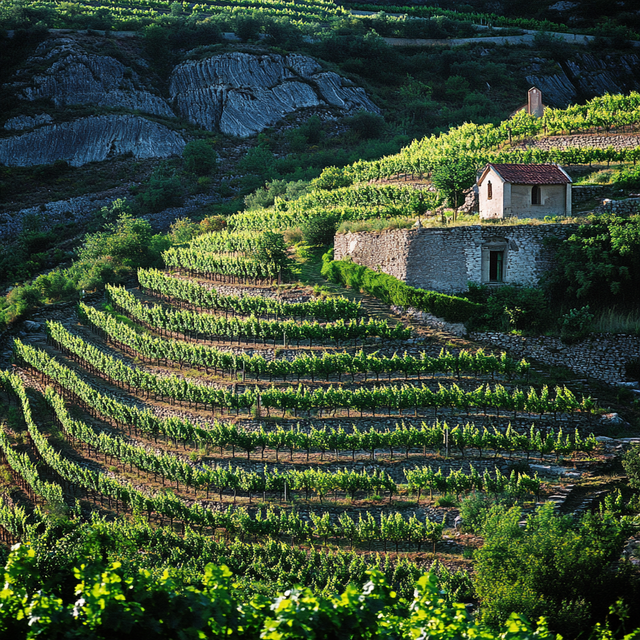
The Rhône Valley is a diverse and historic wine region, divided into two distinct areas. The Northern Rhône is the birthplace of Syrah, with steep, terraced vineyards that produce some of the world's most revered wines, such as those from Hermitage and Côte-Rôtie. The Southern Rhône is much more expansive, offering a wider range of styles, but typically based around Grenache-based blends, with wines from Châteauneuf-du-Pape known for their complexity and power. While the region is celebrated for its reds, it also produces incredible textured whites, and as a whole the region displays the spectrum of French wine and the incredible differences that can come from small geographic changes.
Rhone Valley

Grenache is a widely planted grape variety that thrives in its Mediterranean home. In Spain, it's known as Garnacha, where it reaches its peak in the Sierra de Gredos as a pure varietal wine, while also being a key blending component in Rioja. France's Southern Rhône, notably Châteauneuf-du-Pape, is another well-known region, where Grenache is often the base of a blended wine. Grenache also finds a home in Sardinia as Cannonau, and it has spread beyond its Mediterranean origins, most famously to Australia's Barossa Valley. The resulting wines are typically light in color, yet they possess a full body and flavor, displaying mature red fruit notes, herbal spices, and often a hint of orange peel, along with soft tannins and moderate acidity. It is an incredibly versatile grape, showing different expressions based on its terroir and the winemaking style employed.