

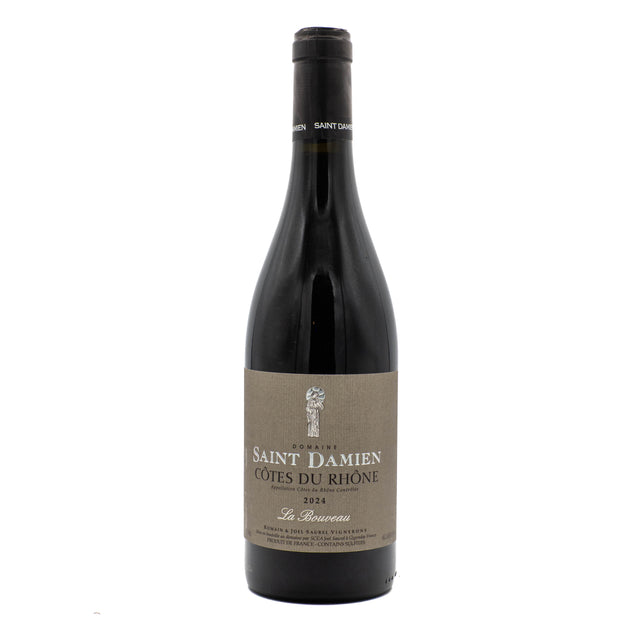
Saint Damien Côtes-du-Rhône La Bouveau 2024
We have 60 in stock (Inventory is live and accurate)
The Land
This is a Côtes-du-Rhône from a Gigondas estate, and the reason is geography rather than ambition. La Bouveau is a lieu-dit in the commune of Violès, on the flat ground below the Dentelles de Montmirail, where the clay and limestone parcels sit too close to the river to fall inside the Gigondas line. The soils are Quaternary river alluvium: deeper, cooler and more water-retentive than the stony terraces up the hill. Vines here do not struggle the way old Grenache does on the Gigondas slopes, so the wine comes out juicier and more fruit-driven, with less of the dense, sun-baked weight of its neighbor. The Mistral dries the canopy after rain, which is what makes organic farming on the valley floor workable.
The Wine
80% Syrah from young vines and 20% Cinsault from vines planted in 1954. That makes this a Syrah-led Côtes-du-Rhône, unusual in a southern Rhône dominated by Grenache. The two varieties are blended in the vat and macerated together for three weeks in concrete, then aged six months in the same concrete tanks and bottled without fining or filtration. No oak touches it. In past vintages the wine has shown blackberry, blueberry and black olive, with cracked pepper and violet from the Syrah and a silky, lifted texture from the old Cinsault; expect the same shape here. 2024 was a cooler, wetter season in the southern Rhône than the run of hot years before it, with mildew pressure and smaller crops, and the reds came in fresher and lower in alcohol. Medium-bodied, fine-grained tannins, a peppery finish.
The People
The Saurel family has farmed vines around Gigondas since 1821, and for most of that time sold the fruit to négociants. Joël Saurel began estate bottling in 1996, brought in consulting winemaker Philippe Cambie two years later, and turned Domaine Saint Damien into one of the reference names for traditional Gigondas, bottled by soil type and raised in concrete and large old foudres. His son Romain now runs the cellar. The domaine takes its name from a chapel to Saint Damien, an early Christian martyr and patron saint of doctors, in the hamlet of La Baumette outside Gigondas where the family lives. The vineyards have been certified organic since 2012.
Food Pairing
Beef chili with ancho and cumin, simmered long enough that the meat falls apart: the Syrah pepper meets the spice and the concrete-raised fruit stays fresh against the heat. Lamb merguez with charred peppers and harissa yogurt. Seared duck breast with black olive tapenade, which picks up the olive note in the wine. A mushroom and lentil shepherd's pie for a meatless night. Pour it slightly cool, around 60 degrees. This is the red to keep a few of on the counter from October through March.
We ship wine to most states with a $100 minimum order for shipping. We don't ship spirits nor beer.
Weather shipping advisory: Orders placed during times of extreme heat or extreme cold will be held for no charge until more favorable weather returns.
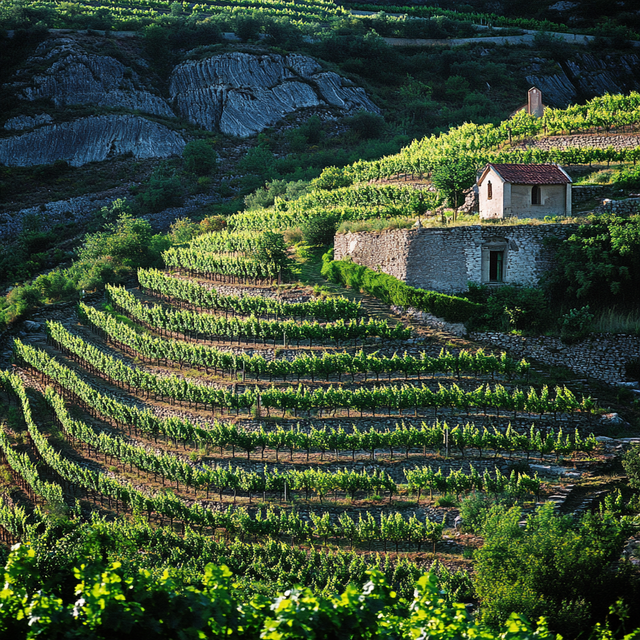
The Rhône Valley is a diverse and historic wine region, divided into two distinct areas. The Northern Rhône is the birthplace of Syrah, with steep, terraced vineyards that produce some of the world's most revered wines, such as those from Hermitage and Côte-Rôtie. The Southern Rhône is much more expansive, offering a wider range of styles, but typically based around Grenache-based blends, with wines from Châteauneuf-du-Pape known for their complexity and power. While the region is celebrated for its reds, it also produces incredible textured whites, and as a whole the region displays the spectrum of French wine and the incredible differences that can come from small geographic changes.
Rhone Valley

Grenache is a widely planted grape variety that thrives in its Mediterranean home. In Spain, it's known as Garnacha, where it reaches its peak in the Sierra de Gredos as a pure varietal wine, while also being a key blending component in Rioja. France's Southern Rhône, notably Châteauneuf-du-Pape, is another well-known region, where Grenache is often the base of a blended wine. Grenache also finds a home in Sardinia as Cannonau, and it has spread beyond its Mediterranean origins, most famously to Australia's Barossa Valley. The resulting wines are typically light in color, yet they possess a full body and flavor, displaying mature red fruit notes, herbal spices, and often a hint of orange peel, along with soft tannins and moderate acidity. It is an incredibly versatile grape, showing different expressions based on its terroir and the winemaking style employed.