


September ’26 Drink Better Wine Club Recipes
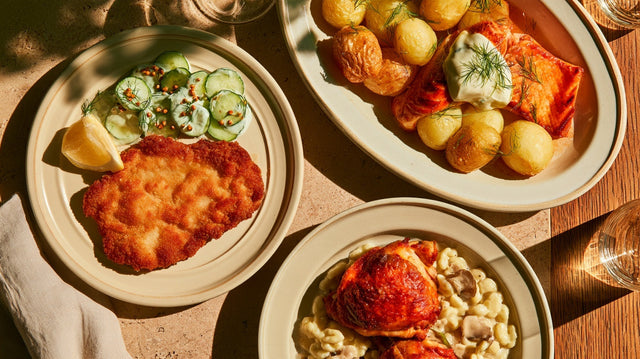
For every wine club selection, we love to offer a food pairing that lets you experience the wine where we think it really belongs: at the table.
This month, we’re heading to Austria, with three wines that show just how much range the country has to offer—from fresh, peppery Grüner Veltliner and powerful Wachau Riesling to juicy, spicy Blaufränkisch from Burgenland.
My goal with these recipes is always the same: food that feels special enough to do justice to the bottle, but approachable enough that you’ll actually want to make it at home. And Austria gave me plenty to work with. This month we're leaning into crispy schnitzel, dill, mustard seed, horseradish, brown butter, paprika, mushrooms and spätzle—all flavors that absolutely belong next to these wines.

PORK SCHNITZEL WITH CREAMY CUCUMBER, DILL & MUSTARD SEED SALAD
Wine Pairing: Emmerich Knoll Loibner Grüner Veltliner Federspiel 2025
Serves 2–4
There are some pairings where there’s really no reason to reinvent the wheel. Grüner Veltliner and schnitzel is one of them.
The schnitzel is thin, crispy and salty, with plenty of fresh lemon squeezed over the top. Alongside it, a cool cucumber salad with dill, sour cream, vinegar and toasted mustard seeds brings acidity and freshness to the plate.
Knoll’s Loibner Federspiel has exactly what this dish needs: freshness, orchard and stone fruit, herbal character and Grüner’s classic peppery spice. The wine cuts through the fried crust, while the cucumber, dill and mustard seed bring out its savory, herbal side. Simple, classic and ridiculously good together.
INGREDIENTS
For the schnitzel
• 1 lb boneless pork loin chops, about 4 pieces
• Kosher salt and freshly ground black pepper
• ½ cup all-purpose flour
• 2 large eggs
• 1 tbsp milk or water
• 1 cup fine plain breadcrumbs
• Neutral oil, for frying
• 1 lemon, cut into wedges
• Chopped parsley, for serving
For the cucumber salad
• 1 large English cucumber, very thinly sliced
• ½ tsp kosher salt
• ¼ cup sour cream
• 1½ tbsp white wine vinegar
• 1 tsp Dijon mustard
• 1 tsp honey
• 2 tbsp finely chopped fresh dill
• 1 tbsp mustard seeds
• Freshly ground black pepper
INSTRUCTIONS
1. Make the cucumber salad. Toss the sliced cucumber with ½ teaspoon salt and let it sit in a colander for about 15 minutes. Gently squeeze or blot away the excess moisture.
2. Toast the mustard seeds in a dry skillet over medium heat for 1–2 minutes, until fragrant. Remove from the heat.
3. In a bowl, whisk together the sour cream, vinegar, Dijon and honey. Fold in the cucumber, dill and toasted mustard seeds. Season with black pepper and additional salt if needed. Refrigerate while you make the schnitzel.
4. Prepare the pork. Place each pork chop between two pieces of plastic wrap or parchment and pound until approximately ¼-inch thick. Season both sides generously with salt and pepper.
5. Set up three shallow bowls: flour in the first, eggs beaten with milk in the second, and breadcrumbs in the third.
6. Dredge each piece of pork first in flour, shaking off the excess, then egg, then breadcrumbs. Press the breadcrumbs on very lightly—you want a loose coating that can puff away from the meat as it fries.
7. Pour about ¼ inch of neutral oil into a large skillet and heat over medium-high heat. When the oil is hot and shimmering, fry the schnitzel in batches for approximately 2–3 minutes per side, until deeply golden and cooked through.
8. Transfer to a paper towel-lined plate or wire rack and immediately season with a little salt.
9. Serve the schnitzel hot with plenty of lemon, parsley and the cold cucumber salad alongside.
PAIRING NOTE
Don’t be shy with the lemon. The acidity is part of what makes this pairing work so well. Serve the Grüner well chilled, but not ice cold.

ROASTED SALMON WITH LEMON BROWN BUTTER, CRISPY POTATOES & HORSERADISH CRÈME FRAÎCHE
Wine Pairing: Josef Fischer Riesling Smaragd Ried Steiger 2021
Serves 2–4
This is the slightly more luxurious dinner of the three, but it’s still incredibly easy to make.
Salmon gives the Riesling enough richness to push against, while crispy potatoes and nutty brown butter match the depth of a Smaragd beautifully. Lemon and dill keep everything fresh, and a little horseradish crème fraîche gives the dish just enough sharpness without overpowering the wine.
The key here is balance. This is a substantial dry Riesling, so I wanted a dish with richness and texture rather than something delicate. At the same time, Riesling’s acidity keeps the brown butter and salmon from ever feeling heavy.
INGREDIENTS
For the salmon and potatoes
• 1–1¼ lb skin-on salmon fillet, cut into 2–4 portions
• 1 lb baby Yukon Gold potatoes, halved
• 2 tbsp olive oil
• Kosher salt and freshly ground black pepper
• 1 tbsp chopped fresh dill, plus more for serving
• Lemon wedges, for serving
For the horseradish crème fraîche
• ½ cup crème fraîche or sour cream
• 1–2 tbsp prepared horseradish, to taste
• 1 tsp fresh lemon juice
• Pinch of kosher salt
For the lemon brown butter
• 4 tbsp unsalted butter
• 1 small garlic clove, finely grated or minced
• Zest of ½ lemon
• 1 tbsp fresh lemon juice
• 1 tbsp chopped fresh dill
• Pinch of kosher salt
INSTRUCTIONS
1. Preheat the oven to 425°F.
2. Toss the potatoes with olive oil, salt and pepper. Arrange cut-side down on a sheet pan and roast for 25–30 minutes, until deeply golden and crisp.
3. Meanwhile, make the horseradish crème fraîche. Stir together the crème fraîche, horseradish, lemon juice and a pinch of salt. Taste and add more horseradish if you want a little more bite. Refrigerate until serving.
4. Pat the salmon dry and season generously with salt and pepper.
5. When the potatoes have about 12 minutes remaining, place the salmon skin-side down on a separate parchment-lined sheet pan. Roast for approximately 8–12 minutes depending on thickness and your preferred doneness.
6. Make the brown butter. Melt the butter in a small saucepan over medium heat. Continue cooking, swirling occasionally, until it foams and the milk solids turn golden brown and smell nutty, about 3–5 minutes.
7. Immediately remove the pan from the heat. Add the garlic, lemon zest and lemon juice carefully—the butter may sputter. Stir in the dill and a small pinch of salt.
8. Spoon the lemon brown butter over the roasted salmon. Serve with the crispy potatoes and a generous spoonful of horseradish crème fraîche. Finish with fresh dill and lemon wedges.
PAIRING NOTE
Smaragd is the fullest-bodied category of dry Wachau wine, and this 2021 has had several years in bottle to develop. That extra weight and complexity is exactly why we can bring brown butter, oily salmon and horseradish into the equation. The dish is rich; the Riesling makes it feel almost effortless.

PAPRIKA-ROASTED CHICKEN THIGHS WITH CREAMY MUSHROOM SPÄTZLE
Wine Pairing: Gesellmann Blaufränkisch vom Lehm 2023
Serves 4
If you haven’t cooked much with Blaufränkisch in mind, start here.
Gesellmann’s Blaufränkisch vom Lehm comes from Mittelburgenland and has everything I love about the grape: dark and red fruit, pepper, savory spice, freshness and enough tannin to give it structure without making it remotely heavy.
Rather than putting it next to a giant piece of beef, I wanted something that played into the wine’s spice and earthiness. Paprika-roasted chicken thighs give us crispy skin and savory depth, while mushrooms and creamy spätzle pick up the wine’s earthier side. This is cozy Austrian comfort food and probably my favorite pairing of the month.
INGREDIENTS
For the chicken
• 4 bone-in, skin-on chicken thighs
• 1 tbsp olive oil
• 2 tsp sweet Hungarian paprika
• ½ tsp smoked paprika
• 1 tsp kosher salt
• ½ tsp freshly ground black pepper
• ½ tsp dried thyme
• 2 garlic cloves, finely grated or minced
For the mushroom spätzle
• 12 oz dried spätzle
• 2 tbsp unsalted butter, divided
• 8 oz cremini mushrooms, sliced
• 1 small shallot, finely chopped
• 1 garlic clove, minced
• ½ cup chicken stock
• ½ cup heavy cream
• 1 tsp Dijon mustard
• ¼ cup finely grated Parmesan
• Kosher salt and freshly ground black pepper
• 2 tbsp chopped fresh parsley
• Optional: squeeze of fresh lemon juice
INSTRUCTIONS
1. Preheat the oven to 425°F.
2. Pat the chicken thighs very dry. Combine the olive oil, sweet paprika, smoked paprika, salt, pepper, thyme and garlic. Rub the mixture all over the chicken.
3. Arrange the thighs skin-side up on a sheet pan or in an oven-safe skillet. Roast for 35–45 minutes, until the skin is deeply browned and crisp and the chicken is cooked through.
4. Meanwhile, cook the spätzle according to the package directions. Drain and set aside.
5. Melt 1 tablespoon butter in a large skillet over medium-high heat. Add the mushrooms and cook without stirring too frequently so they have a chance to brown, about 6–8 minutes.
6. Add the shallot and cook another 2–3 minutes. Add the garlic and cook for about 30 seconds.
7. Pour in the chicken stock and scrape up any browned bits from the bottom of the pan. Let it reduce by roughly half.
8. Lower the heat to medium-low and stir in the heavy cream and Dijon. Simmer gently for 2–3 minutes until slightly thickened.
9. Add the cooked spätzle, Parmesan and remaining tablespoon of butter. Toss until everything is glossy and coated. If the sauce becomes too thick, loosen it with another splash of chicken stock.
10. Season with salt and plenty of freshly ground black pepper. Finish with parsley and, if the sauce needs a little lift, a small squeeze of lemon.
11. Spoon the creamy mushroom spätzle onto plates and top or serve alongside the crispy paprika chicken.
PAIRING NOTE
This is exactly where Blaufränkisch shines. The paprika and black pepper echo the wine’s savory spice, mushrooms pull out its earthy character, and the wine’s fresh acidity cuts straight through the creamy spätzle and crispy chicken skin. Most importantly, neither the food nor the wine overwhelms the other. Pour the Blaufränkisch slightly cool—around cellar temperature rather than warm room temperature.
A FINAL NOTE
Austria is one of those wine countries that makes pairing dinner almost too easy. The wines tend to have the acidity, freshness and savory character that make you want another bite and another sip—which, to me, is the entire point of a good food and wine pairing.
You absolutely do not need to make all three recipes, but if one of these bottles inspires you to cook something new this month, I’ve done my job.
As always, these recipes are meant to be played with. Taste as you go, make them your own, and most importantly, open the wine while you’re cooking.
Cheers!
Sally
Denver Wine Merchant
0 Comments
There are no comments for this article. Be the first one to leave a message!