Skip to content
Welcome to Colorado's best wine shop!

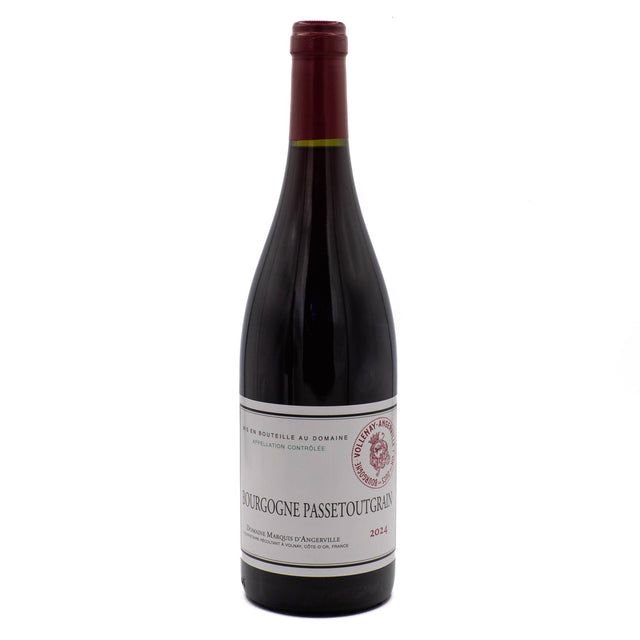
Domaine Marquis d’Angerville Bourgogne Passetoutgrain 2024

$74.00

We have 2 in stock (Inventory is live and accurate)

The Land

Bourgogne Passetoutgrains is one of Burgundy's oldest styles and one of its most overlooked. The name means roughly "pass all the grapes," a nod to the days when Pinot Noir and Gamay grew side by side and went into the vat together. The rules require at least 30% Pinot Noir and 15% Gamay, and traditionally the wine came from flatter, clay-rich ground below the famous slopes, the vineyards that fed the growers' own tables. It sat at the bottom of Burgundy's quality pyramid for decades. A handful of serious domaines kept making it anyway, because a light, juicy red from their own vines was exactly what they wanted to drink on a Tuesday. D'Angerville is one of them.

The Wine

The Domaine Marquis d'Angerville Bourgogne Passetoutgrain 2024 is a roughly even split of Gamay and Pinot Noir, raised with no new oak so the fruit carries the wine. 2024 was a very wet year across Burgundy, with rainfall near double normal through winter and spring, poor flowering for the red grapes and months of mildew pressure. Guillaume d'Angerville has called it the worst growing season he has seen. The upside of a cool, damp year for a wine like this is freshness: bright acidity and clear, unforced fruit. Cherries up front, a flinty edge and a touch of spice, then a crisp, clean, focused finish. Gamay from Burgundy brings the lift and energy, and Pinot Noir brings the frame and perfume.

The People

Guillaume d'Angerville did not plan to run a wine estate. He built a career in investment banking, including senior roles at J.P. Morgan in France, before taking over the family domaine in Volnay when his father Jacques died suddenly in 2003. He has since made more than twenty vintages, converted the vineyards to biodynamic farming beginning in 2006, and moved away from chaptalization, which he says he has not used in two decades. He also serves as president of the association for Burgundy's Climats, the vineyard sites recognized by UNESCO. The Passetoutgrain shows his lighter side. He calls it "a wine for thirst," and says Gamay "brings the joy, the liveliness, to the seriousness of Pinot Noir."

Food Pairing

Treat this like the table wine it was meant to be, with a slight chill, about 20 minutes in the fridge. A charcuterie board with saucisson sec, rillettes and cornichons is the classic Burgundian match, the acidity cutting straight through the fat. Roast chicken with garlic and thyme works every time. Grilled Toulouse sausages over lentils give the Gamay's cherry fruit something smoky to push against, and a croque monsieur with a green salad is lunch sorted. This is the red to keep a few of on hand for pizza night, a picnic in Washington Park, or the evening you want a glass of real Burgundy without a reason.

Select Title

We ship wine to most states with a $100 minimum order for shipping. We don't ship spirits nor beer.

Weather shipping advisory: Orders placed during times of extreme heat or extreme cold will be held for no charge until more favorable weather returns.

0 / 0
The Producer

Domaine Marquis d’Angerville


The Terroir

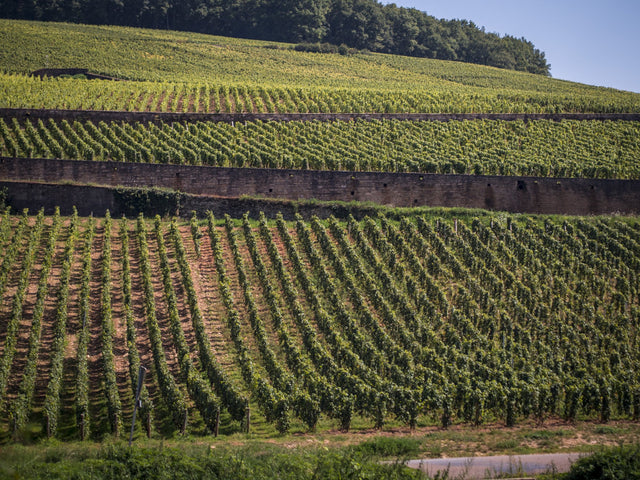
One family farms roughly a tenth of Volnay's premier cru land: 11.2 hectares of it, plus a premier cru in Meursault and a sliver of Pommard. The anchor is the Clos des Ducs, a walled 2.15-hectare monopole at the top of the slope directly behind the family house. Its 52 ouvrées measure the same today as in the vineyard's first recorded mention, in 1507. The soil is thin, stony limestone and white marl on a steep, well-drained pitch facing south-east, and it gives a firmer, slower-opening wine than the Volnays farther down the slope.

Champans is the largest holding at 3.98 hectares, followed by Fremiets (1.57) on the Pommard side, Taillepieds (1.07), Clos des Angles (1.03, with the estate's oldest premier cru vines at 60 to 65 years) and Caillerets (0.45). Another 1.05 hectares of Meursault 1er Cru Santenots supply the white. The vines carry the family's own small-berried strain of Pinot Noir, high in skin and natural tannin, which the BIVB has since propagated for growers across Burgundy.

In 1804 Baron du Mesnil, newly appointed sub-prefect of Autun, bought a 15-hectare domaine in Volnay, a manor house on the north side of the village and the Clos des Ducs, once land of the Dukes of Burgundy. In 1906 Sem, Marquis d'Angerville, bought the whole estate on the death of a du Mesnil uncle. Through the downturn of the late 1920s and early 1930s he led the move to domaine bottling alongside Henri Gouges and Armand Rousseau, and helped shape the appellation system that followed.

His son Jacques worked beside him after the Second World War, took over on Sem's death in 1952 and ran the estate until his own death in 2003, helped in later years by his son-in-law Renaud de Villette. Guillaume d'Angerville, the current Marquis, left investment banking to take charge and in 2005 put François Duvivier in charge of vines and cellar. Conversion to biodynamics began in 2006 and was complete by 2009. Guillaume also owns Domaine du Pélican in the Jura.

The Reds

Every red is fully destemmed and fermented warm, spending two to three weeks on the skins with pump-overs in place of punch-downs for a gentler extraction. The wines then sit through two winters in barrel, with about a fifth to a quarter new oak on the premiers crus.

  • Volnay 1er Cru Clos des Ducs The 2.15-hectare walled monopole, vines 40 to 45 years old. Guillaume calls it the "Cistercian" wine of the cellar: reserved at first, then filling out with red fruit over a firm frame. Give it a decade.
  • Volnay 1er Cru Champans The domaine's largest holding, 3.98 hectares beside Caillerets, vines 40 to 45 years old. More open than Clos des Ducs when young, with the firmest frame of the other premiers crus.
  • Volnay 1er Cru Taillepieds 1.07 hectares from the original 1804 purchase, vines 30 to 35 years old. Layered and deep, between the perfume of Caillerets and the frame of Champans.
  • Volnay 1er Cru Caillerets Only 0.45 hectares, vines 30 to 35 years old; in frost-hit 2021 the whole cuvée fit in a single barrel. The most perfumed wine in the range.
  • Volnay 1er Cru Clos des Angles 1.03 hectares of 60- to 65-year-old vines, the oldest premier cru holding at the domaine. Frost meant no 2016; it returned in 2017.
  • Volnay 1er Cru Fremiets 1.57 hectares on the Pommard side of the village, vines 30 to 35 years old.
  • Volnay 1er Cru 0.96 hectares of 20- to 25-year-old premier cru vines, bottled under the premier cru name without a site. The house style, ready sooner than the single-vineyard wines.
  • Volnay 0.49 hectares of village vines averaging 60 to 65 years old. Old-vine Volnay at village price, and the place to start with this domaine.
  • Pommard 1er Cru Combes Dessus A 0.38-hectare parcel now being replanted, so the wine is on pause.
  • Bourgogne Rouge Pinot Noir at regional level, farmed biodynamically like the rest of the estate. The lowest-priced way into the house style.
  • Bourgogne Passetoutgrain Pinot Noir and Gamay in the old Burgundian blend. Light, red-fruited and low in alcohol (11.5 percent in 2021); drink it young and cool.

The Whites

Whites are a small sideline at this red-wine house, all from the same biodynamically farmed vines. The Meursault ferments and ages in barrel.

  • Meursault 1er Cru Santenots Chardonnay from 1.05 hectares of 20- to 25-year-old vines, and the domaine's only white above regional level. Like Clos des Angles, it lost 2016 to frost.
  • Bourgogne Blanc Chardonnay at regional level, the white counterpart to the Bourgogne Rouge.
  • Bourgogne Aligoté Aligoté from about 0.4 hectares in the lieu-dit Monpoulain, flat land on the eastern side of Volnay. Lean and tart, the counterweight to everything else in the cellar.

Shop all Domaine Marquis d’Angerville (17)

Burgundy, in eastern France, encompasses several subregions, but it is the Côte d'Or that is home to many of the world's most expensive and revered wines. The region, primarily a single east-facing slope, has mixed limestone soils that vary dramatically from village to village and even vineyard to vineyard. White wines, crafted from Chardonnay, range from rich and opulent to lean and intensely mineral, while Pinot Noir produces silky, perfumed red wines of exceptional finesse and complexity. Centuries of winemaking tradition have resulted in every plot being meticulously recognized and scrutinized, making the Côte d'Or a true capital of terroir.

Burgundy - Cote d'Or


Pinot Noir is a thin-skinned, notoriously difficult-to-grow, low-yielding grape that finds its ancestral home in Burgundy, France, where it produces some of the world's most elegant and nuanced wines. While Burgundy remains its spiritual heartland, Pinot Noir has since traveled the globe, finding success in other cooler climates, notably in California, Oregon, New Zealand, and Germany. This grape is a challenge for any grower, as it requires specific conditions to show its best, and yet the wines it produces are capable of such a captivating and singular character.

Pinot Noir

A red wine grape most associated with Beaujolais, Gamay makes fresh, fruity red wines with berry and violet aromas. It is grown around the world outside of France where it is often a darker and less tannic cousin to Pinot Noir in cool climate regions such as Oregon and Victoria.

Gamay