

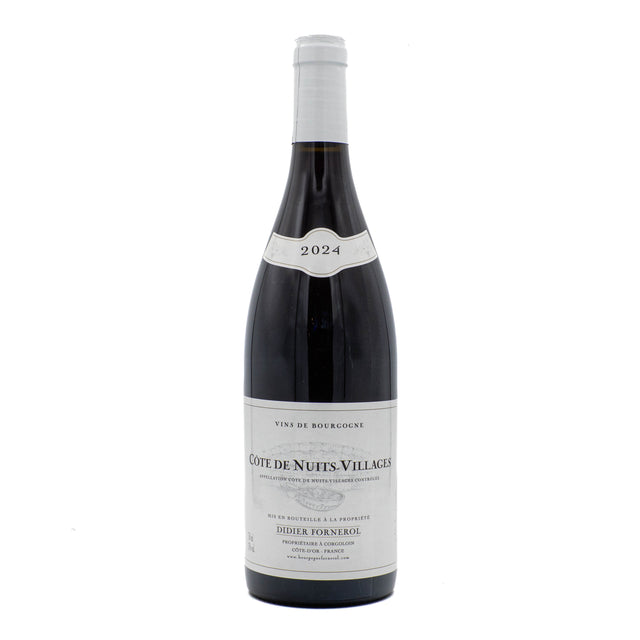
Didier Fornerol Cote de Nuits Villages Rouge 2024
We have 12 in stock (Inventory is live and accurate)
Summer Shipping Advisory: Orders may be temporarily held during periods of extreme heat to ensure wine arrives in optimal condition.
View current shipping weather map →
The Land
Corgoloin is the last village of the Côte de Nuits before the slope turns into the Côte de Beaune, and it has never had an appellation of its own. Its reds are sold as Côte de Nuits-Villages, a catch-all created in 1964 for five villages at either end of the Côte: Fixin and Brochon in the north, Premeaux-Prissey, Comblanchien and Corgoloin in the south. That label hides real terroir. Corgoloin sits on the same escarpment as Nuits-Saint-Georges, on the Jurassic limestone that is quarried just up the road in Comblanchien. Didier Fornerol's Côte de Nuits-Villages rouge comes from 3.70 hectares of vines in several parcels west of the village, on brown limestone soils.
The Wine
Pinot Noir, fermented entirely as whole clusters with no destemming at all. Didier punches down by hand, with an occasional pump-over, at slightly warmer temperatures than he uses for his whites. The wine then spends 14 to 16 months in barrel with about 10% new oak and is racked no more than twice. Whole bunches do the heavy lifting here: the stems bring a savory, herbal lift and a finer grip than destemmed Pinot, and they keep the fruit crunchy. Red cherry and wild strawberry, a darker edge of plum, crushed rock, a little clove, all on silky tannin. The 2024 growing season was one of the hardest in recent memory, with rain more than 55% above average, persistent mildew, and a drawn-out flowering that cut yields across the Côte. What survived ripened slowly and was picked in mid-September. The reds are floral and fresh, with modest alcohol, closer to 2016 or 2010 in shape than to the heavier warm years.
The People
Before he had a label of his own, Didier Fornerol spent the 1980s and 1990s as vineyard manager and cellar master at Domaine de l'Arlot in Premeaux, working under Jean-Pierre de Smet, the man who made l'Arlot's name and one of Burgundy's early champions of whole-cluster fermentation. In 1999 Didier took over his family's domaine in Corgoloin. After de Smet stepped away from l'Arlot in the mid-2000s, he came to help in Didier's cellar, and the house style reflects both men. The domaine totals about 6 hectares, farmed lutte raisonnée with minimal synthetic treatments, and Didier handles the pruning, trellising, spraying and hand harvest with a very small team. 2024 is his final vintage. He has leased out his vines and retires once these wines are bottled, which makes this Didier Fornerol Côte de Nuits-Villages 2024 the last of its line.
Food Pairing
Start with oeufs en meurette, eggs poached in red wine with lardons and mushrooms, the Burgundian dish built for exactly this wine. Crisp-skinned salmon over beluga lentils with a mustard vinaigrette works because the fresh acid and light tannin meet the fish without flattening it. A slice of jambon persillé with cornichons gives the stem spice some salt and brine to push against. On a lazy night, a mushroom and thyme flatbread with fontina does the job too. This is the everyday Burgundy you buy two of, one for Tuesday and one to hold for a year to see what whole clusters do with time.
We ship wine to most states with a $100 minimum order for shipping. We don't ship spirits nor beer.
Weather shipping advisory: Orders placed during times of extreme heat or extreme cold will be held for no charge until more favorable weather returns.
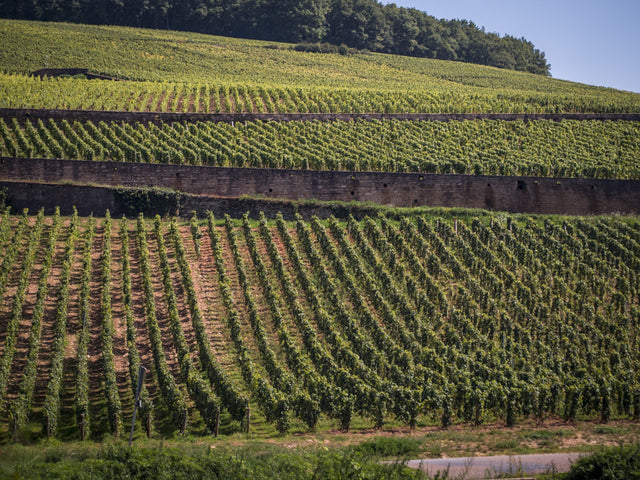
Burgundy, in eastern France, encompasses several subregions, but it is the Côte d'Or that is home to many of the world's most expensive and revered wines. The region, primarily a single east-facing slope, has mixed limestone soils that vary dramatically from village to village and even vineyard to vineyard. White wines, crafted from Chardonnay, range from rich and opulent to lean and intensely mineral, while Pinot Noir produces silky, perfumed red wines of exceptional finesse and complexity. Centuries of winemaking tradition have resulted in every plot being meticulously recognized and scrutinized, making the Côte d'Or a true capital of terroir.
Burgundy - Cote d'Or

Pinot Noir is a thin-skinned, notoriously difficult-to-grow, low-yielding grape that finds its ancestral home in Burgundy, France, where it produces some of the world's most elegant and nuanced wines. While Burgundy remains its spiritual heartland, Pinot Noir has since traveled the globe, finding success in other cooler climates, notably in California, Oregon, New Zealand, and Germany. This grape is a challenge for any grower, as it requires specific conditions to show its best, and yet the wines it produces are capable of such a captivating and singular character.