

Edmond Cornu & Fils Ladoix 1er Cru La Corvee 2019
We have 4 in stock (Inventory is live and accurate)
The Land
Ladoix is the Côte de Beaune village almost nobody names, even though it shares the Corton grand cru with Aloxe-Corton and Pernand-Vergelesses. Ladoix-Serrigny is one commune made up of Serrigny and two hamlets, Ladoix at the foot of the Corton hill and Buisson just to the north, and its vines run past the hill to the Corgoloin border, where the Côte de Nuits begins. La Corvée lies up behind Buisson at the northern end of the appellation, on a gentle slope of chalky clay. That northern position gives parts of Ladoix soils closer to the Côte de Nuits, and Pierre Cornu calls La Corvée a Côte de Beaune wine with Côte de Nuits character. About four-fifths of Ladoix is red, and this is Ladoix premier cru red wine at full strength.
The Wine
Edmond Cornu & Fils Ladoix 1er Cru La Corvée 2019 is 100% Pinot Noir, fully destemmed and fermented in stainless steel at 30 to 32°C, with pigeage and remontage adjusted to each year's structure. The domaine holds off the start of fermentation by about five days to lengthen maceration, then ages the wine 15 to 20 months in small barrels, with malolactic in barrel and new oak kept to about 10 percent. Cornu describes La Corvée as the more powerful, concentrated, and darker of his two Ladoix premier crus, with blackberry fruit, and slower to come around than Le Bois Roussot. In 2019 a June heat wave and a hot, windy August stressed the vines, hail on July 14 at nearby Savigny and Corton did limited damage, and the Côte d'Or harvest began September 10 with clean fruit and ripe stems. At seven years, expect blackberry and dark cherry moving toward earth and spice, with firm tannin starting to relax.
The People
The Cornu family settled in Ladoix in 1870, the year Pierre Cornu's great-great-grandfather built the family house, and founded the domaine in 1875. Edmond Cornu took charge in 1956 and began bottling in 1959; until then the family sold everything to négociants. Rosenthal Wine Merchant began importing the wines with the 1978 vintage, making Cornu one of the first estates in its portfolio. Edmond's son Pierre joined his father and now runs the domaine as proprietor, with his cousin Emmanuel Boireau co-supervising vineyard and cellar. Together they went back to full destemming, added a pneumatic press for finer tannin, and installed temperature control. The vineyards stretch across Ladoix, Aloxe-Corton, Chorey, and Savigny, including a share of Corton Bressandes.
Food Pairing
La Corvée has the dark fruit and grip for cold-weather cooking. Boeuf bourguignon braised with lardons, mushrooms, and pearl onions is the obvious match, the tannin softening against long-cooked beef. Venison loin seared rare with a juniper and blackberry sauce mirrors the wine's fruit. Roast guinea hen with chestnuts and Brussels sprouts lets the acidity keep the bird lively. Finish with a wedge of washed-rind Abbaye de Cîteaux. This is the bottle to open when the first snow hits the Front Range.
We ship wine to most states with a $100 minimum order for shipping. We don't ship spirits nor beer.
Weather shipping advisory: Orders placed during times of extreme heat or extreme cold will be held for no charge until more favorable weather returns.
Burgundy, in eastern France, encompasses several subregions, but it is the Côte d'Or that is home to many of the world's most expensive and revered wines. The region, primarily a single east-facing slope, has mixed limestone soils that vary dramatically from village to village and even vineyard to vineyard. White wines, crafted from Chardonnay, range from rich and opulent to lean and intensely mineral, while Pinot Noir produces silky, perfumed red wines of exceptional finesse and complexity. Centuries of winemaking tradition have resulted in every plot being meticulously recognized and scrutinized, making the Côte d'Or a true capital of terroir.
Burgundy - Cote d'Or

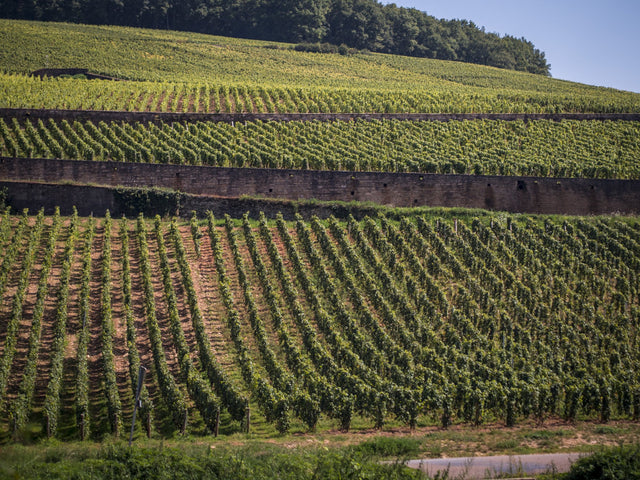
Pinot Noir is a thin-skinned, notoriously difficult-to-grow, low-yielding grape that finds its ancestral home in Burgundy, France, where it produces some of the world's most elegant and nuanced wines. While Burgundy remains its spiritual heartland, Pinot Noir has since traveled the globe, finding success in other cooler climates, notably in California, Oregon, New Zealand, and Germany. This grape is a challenge for any grower, as it requires specific conditions to show its best, and yet the wines it produces are capable of such a captivating and singular character.