

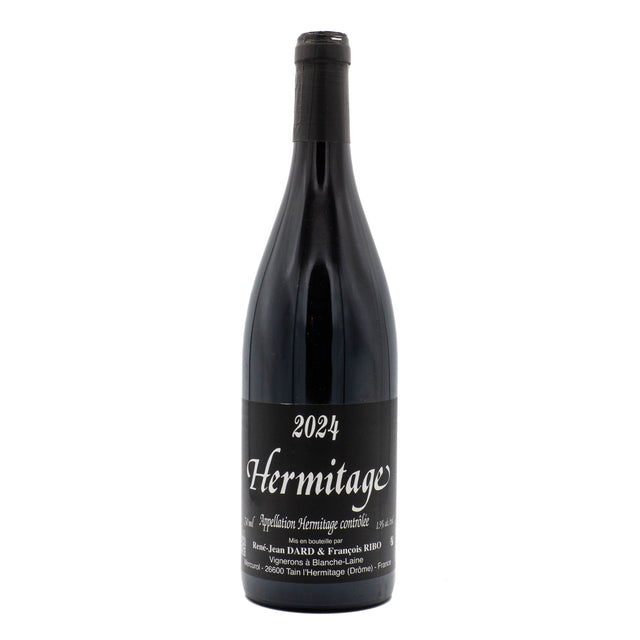
Dard & Ribo Hermitage 2024
We have 2 in stock (Inventory is live and accurate)
Summer Shipping Advisory: Orders may be temporarily held during periods of extreme heat to ensure wine arrives in optimal condition.
View current shipping weather map →
The Land
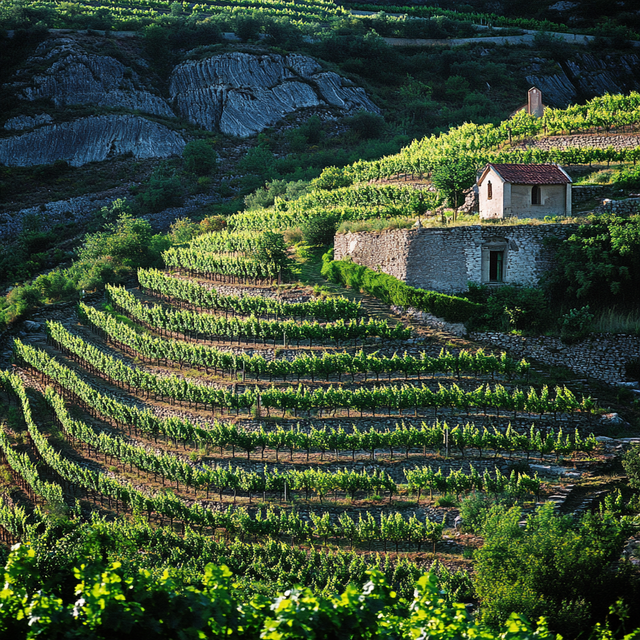
Hermitage is small enough to walk across in an afternoon and famous enough that its wines outpriced first-growth Bordeaux through the 18th and 19th centuries, when Bordeaux quietly bought them for blending. The appellation covers roughly 136 hectares on a granite outcrop that turns hard against the run of the northern Rhone, facing due south above Tain-l'Hermitage instead of southeast along the river. Granite sits exposed at the western end, while the eastern lieux-dits layer loess, glacial deposit and clay over the rock, which is why one hill supports Syrah and the Marsanne and Roussanne of Hermitage blanc within a few hundred meters. Dard and Ribo hold well under a hectare here, split across small parcels with mixed plantings of all three, some acquired as recently as 2016 and some carrying vines planted in 1910.
The Wine
One thing to settle first: Dard and Ribo bottled both an Hermitage rouge and an Hermitage blanc in 2024, and the color of this bottling has not been confirmed. Treat it as open until the label is in hand. The handling is consistent across both. Fruit goes into open wooden vats, the reds fermented with a high proportion of whole bunches and worked with pumpovers and punchdowns rather than hard extraction. The whites are racked without debourbage, so the gross lees are pushed out during fermentation rather than settled off beforehand, which is where their grain comes from. Elevage runs about 12 months in used 600-liter casks, unfined and unfiltered, sulfur minimal to absent. The 2024 season was wet and fungal across the northern Rhone, precipitation 84 percent above the long-term average, fruit set badly hit, volumes small. What came through carries lift rather than mass: the reds red-fruited and peppery, the whites taut and saline.
The People
Eight and a half hectares across seven villages, and roughly 35 percent of it planted to white varieties in a region that averages closer to 10 percent. That ratio tells you how Rene-Jean Dard and Francois Ribo think. They met at wine school in Beaune in their late teens, Dard from Tournon in the Ardeche and Ribo from Tain-l'Hermitage in the Drome, and founded the domaine in 1983. They keep their own massal selections of Roussanne rather than buying clonal material, work the steepest terraces with a horse and a cable pulley, and treat only with copper and sulfur. Their holdings on the hill are fractions of a hectare.
Food Pairing
The color is unconfirmed, so here is a plan for either. If it is rouge, roast a duck with cracked pepper and braised endive, the bitterness meeting the savory edge of the Syrah, or take a rib of beef salted hard and cooked over coals. If it is blanc, Hermitage white wants richness and salt: turbot roasted whole with brown butter and capers, or sweetbreads with morels and cream, where the saline finish cuts through the sauce. Either way, this is not a Tuesday bottle. Give it a decanter and the meal it was built for.
We ship wine to most states with a $100 minimum order for shipping. We don't ship spirits nor beer.
Weather shipping advisory: Orders placed during times of extreme heat or extreme cold will be held for no charge until more favorable weather returns.
The Rhône Valley is a diverse and historic wine region, divided into two distinct areas. The Northern Rhône is the birthplace of Syrah, with steep, terraced vineyards that produce some of the world's most revered wines, such as those from Hermitage and Côte-Rôtie. The Southern Rhône is much more expansive, offering a wider range of styles, but typically based around Grenache-based blends, with wines from Châteauneuf-du-Pape known for their complexity and power. While the region is celebrated for its reds, it also produces incredible textured whites, and as a whole the region displays the spectrum of French wine and the incredible differences that can come from small geographic changes.
Rhone Valley

Syrah is a dark-skinned grape of French origin, specifically from the Northern Rhône Valley, where it produces some of the world's most powerful and complex wines. Known as Shiraz in Australia, Syrah is capable of displaying a wide range of aromas and flavors. Cool climate Syrahs tend to express floral notes like violets, along with savory elements like olives, while those grown in warmer climates like Australia are more likely to show black pepper and dark fruit notes such as plum. The grape's versatility allows it to adapt to various climates and soil types, but it maintains its unique characteristics no matter where it is planted.