

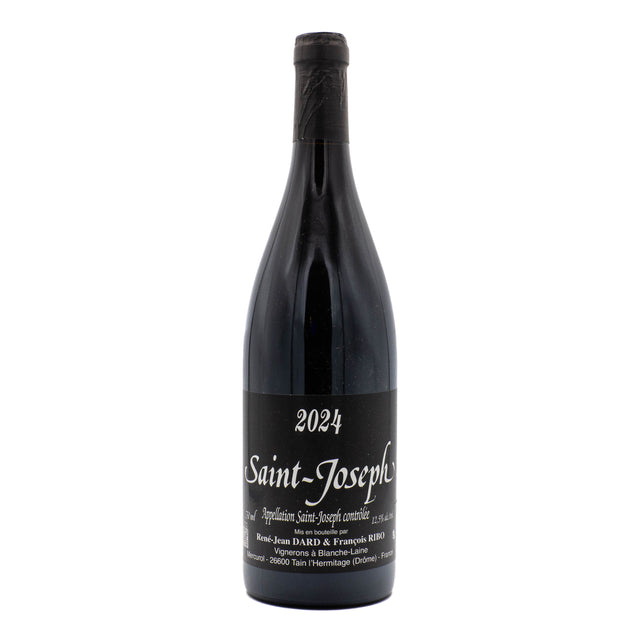
Dard & Ribo Saint-Joseph Rouge 2024
We have 3 in stock (Inventory is live and accurate)
Summer Shipping Advisory: Orders may be temporarily held during periods of extreme heat to ensure wine arrives in optimal condition.
View current shipping weather map →
The Land
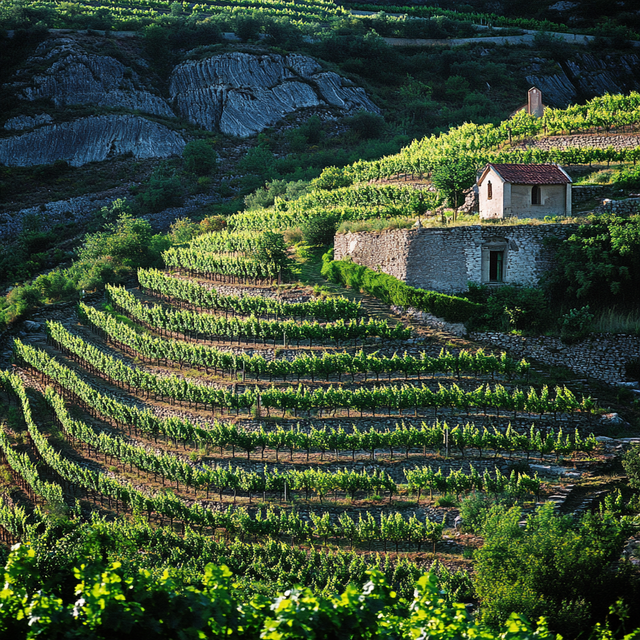
Saint-Joseph takes its name from a single Jesuit-owned lieu-dit at Mauves, a few hectares of granite terrace. The appellation now runs across 26 communes and roughly 50 kilometers of the right bank, and the gap between the historic terraces and the later flatland extensions is the gap between a serious wine and a cheap one. This bottling comes entirely off the old core, three parcels in three villages. Half is Pitrou, above Saint-Jean-de-Muzols, on sandy decomposed granite. Half is Les Champs at Tournon, a harder granite shot through with quartz, red clay and alluvial stone. A smaller share comes from sandy granite at Vion. The granite gives Syrah lift and a fine, dusty tannin; the clay and rolled stone at Tournon supply the flesh.
The Wine
Syrah, from vines spanning four decades of planting: the 1940s and 1950s at Pitrou, the 1960s at Les Champs, the 1970s at Vion. Fermentation is whole bunch in open wooden vats worked with pumpovers rather than hard extraction, followed by 10 to 12 months in used 600-liter casks, then bottling unfined and unfiltered with minimal to no added sulfur. Raspberry and wild strawberry over a dry, sandy mineral edge and a flick of cordite, then a red-fruited, floral middle, rose petal more than violet, with bright acidity and tannin that registers as texture rather than grip. 2024 was a hard year to farm organically here. Rainfall ran 84 percent above the long-term average, downy mildew never let up, and cool wet flowering left uneven fruit set and small crops. August warmth saved it, and the 2024 reds came in lighter and more aromatic than the 2023s, which is the register this wine works in anyway.
The People
Rene-Jean Dard's definition of natural wine is worth repeating for how unromantic it is: wine that is alive, and wine that does not necessarily have to be kept. They vinify plot by plot and blend late, favor light extraction over concentration, and aim at wines meant to be drunk rather than stored. Dard came to this honestly. His father added no sulfur, and Dard did not know that was unusual until oenology school in Dijon told him so. He left, trained in Beaune, met Francois Ribo there, and the two founded the domaine in 1983. They farm about 8.5 hectares organically without seeking certification and sell roughly 3 percent of production direct; the rest goes to wine bars, restaurants and importers across 17 countries.
Food Pairing
Saint-Joseph at this weight is a food wine before it is anything else. Pork chops brined and grilled over charcoal, finished with sage butter, meet the sandy tannin without burying it. A pot of white beans braised with pancetta, rosemary and a parmesan rind gives the wild strawberry fruit something savory to sit against. Roast chicken with lemon and black olives works because the acidity in the wine matches the acidity on the plate. Serve it cool, around 60 degrees, and plan on finishing it.
We ship wine to most states with a $100 minimum order for shipping. We don't ship spirits nor beer.
Weather shipping advisory: Orders placed during times of extreme heat or extreme cold will be held for no charge until more favorable weather returns.
The Rhône Valley is a diverse and historic wine region, divided into two distinct areas. The Northern Rhône is the birthplace of Syrah, with steep, terraced vineyards that produce some of the world's most revered wines, such as those from Hermitage and Côte-Rôtie. The Southern Rhône is much more expansive, offering a wider range of styles, but typically based around Grenache-based blends, with wines from Châteauneuf-du-Pape known for their complexity and power. While the region is celebrated for its reds, it also produces incredible textured whites, and as a whole the region displays the spectrum of French wine and the incredible differences that can come from small geographic changes.
Rhone Valley

Syrah is a dark-skinned grape of French origin, specifically from the Northern Rhône Valley, where it produces some of the world's most powerful and complex wines. Known as Shiraz in Australia, Syrah is capable of displaying a wide range of aromas and flavors. Cool climate Syrahs tend to express floral notes like violets, along with savory elements like olives, while those grown in warmer climates like Australia are more likely to show black pepper and dark fruit notes such as plum. The grape's versatility allows it to adapt to various climates and soil types, but it maintains its unique characteristics no matter where it is planted.