

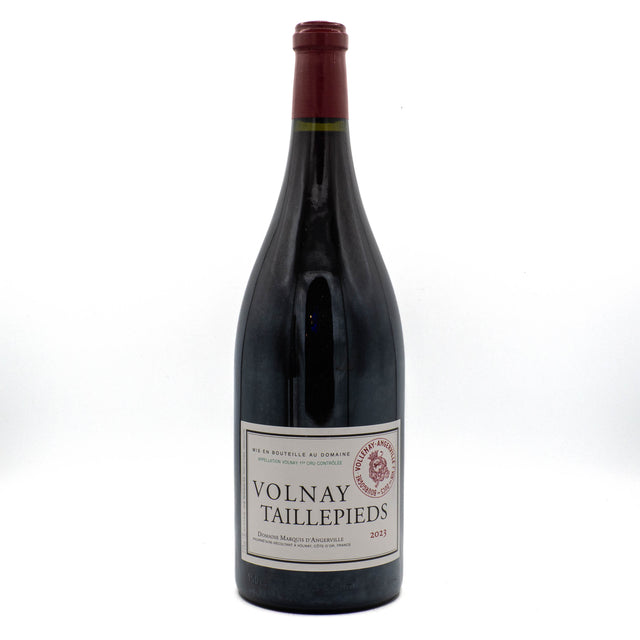
Domaine Marquis d’Angerville Volnay 1er Cru Taillepieds 2023 1.5L
We have 1 in stock (Inventory is live and accurate)
The Land
Taillepieds translates roughly as "cut feet," a name tied to the sharp, stony ground that made this one of the harder premier cru slopes in Volnay to work by hand. The whole climat covers about 7 hectares, mid-slope with a southeast tilt, sitting uphill from Champans and alongside Caillerets and Clos des Chênes. Topsoil is thin, whitish and full of rock over limestone and marl, with a band of clay underneath that holds just enough water through a dry summer. The d'Angerville parcel is steep and poor, the kind of site that caps vigor and keeps berries small. Where Champans below gives Volnay red wine its breadth, Taillepieds gives it spine: more structure, more mineral drive, and a firmer frame than most of the village's premier crus.
The Wine
The Domaine Marquis d'Angerville Volnay 1er Cru Taillepieds 2023 is 100% Pinot Noir, fully destemmed and fermented in the domaine's traditional, low-intervention style with regular pump-overs, then raised in barrel with only a modest share of new oak so the site stays in front. 2023 was a warm, abundant year in the Côte de Beaune. D'Angerville began picking on September 5, did no green harvesting and still brought in about 40 hl/ha. In a vintage where many Volnays leaned ripe and dark, Taillepieds kept its tension: blackberry and red currant, a streak of fresh herbs, then tight, energetic structure and a long, focused finish. This bottling is the magnum, and the larger format slows its development in the cellar, which suits a premier cru built for the long haul.
The People
The d'Angerville name is bound up with the fight for honest Burgundy. In the early twentieth century, when much Burgundy was blended and relabeled by the négociant trade, Sem, Marquis d'Angerville pushed back against those practices and began bottling his own wine at the domaine, one of the first in the region to do so, alongside his friend Henri Gouges. That campaign fed directly into the creation of the Burgundy appellation contrôlée system in the 1930s, and Sem is widely credited as one of its architects. The principle he fought for, that a bottle should say exactly where its wine came from, still defines the house. Taillepieds is a direct expression of it: one named slope, bottled by the family that farms it.
Food Pairing
Taillepieds has the structure for a real centerpiece. Roast a whole duck with orange zest and thyme, and let the wine's acidity and firm tannin cut through the rendered fat. Venison loin seared rare with a juniper and red wine reduction matches its dark berry fruit and herbal edge. Coq au vin, braised slowly with lardons, mushrooms and pearl onions, meets its earthier side. Or keep it simple with an aged Comté or a wedge of Époisses after dinner. A magnum of Volnay premier cru is a bottle to put on the table at a holiday dinner or a milestone birthday, open an hour ahead, and pour for eight.
We ship wine to most states with a $100 minimum order for shipping. We don't ship spirits nor beer.
Weather shipping advisory: Orders placed during times of extreme heat or extreme cold will be held for no charge until more favorable weather returns.
Domaine Marquis d’Angerville
- Est.1804
- RegionBurgundy - Cote d'Or
- FarmingFarming - Certified Biodynamic
- In stock17 wines →
Burgundy, in eastern France, encompasses several subregions, but it is the Côte d'Or that is home to many of the world's most expensive and revered wines. The region, primarily a single east-facing slope, has mixed limestone soils that vary dramatically from village to village and even vineyard to vineyard. White wines, crafted from Chardonnay, range from rich and opulent to lean and intensely mineral, while Pinot Noir produces silky, perfumed red wines of exceptional finesse and complexity. Centuries of winemaking tradition have resulted in every plot being meticulously recognized and scrutinized, making the Côte d'Or a true capital of terroir.
Burgundy - Cote d'Or

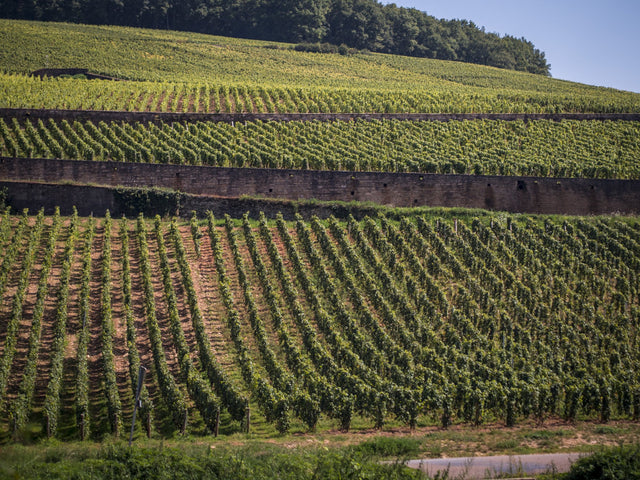
Pinot Noir is a thin-skinned, notoriously difficult-to-grow, low-yielding grape that finds its ancestral home in Burgundy, France, where it produces some of the world's most elegant and nuanced wines. While Burgundy remains its spiritual heartland, Pinot Noir has since traveled the globe, finding success in other cooler climates, notably in California, Oregon, New Zealand, and Germany. This grape is a challenge for any grower, as it requires specific conditions to show its best, and yet the wines it produces are capable of such a captivating and singular character.
Pinot Noir
Certified Biodynamic vineyard farming is a holistic approach building upon organic principles, viewing the vineyard as a self-contained ecosystem influenced by cosmic rhythms. Based on Rudolf Steiner's teachings, it integrates precise agricultural methods with lunar and astrological calendars, using natural preparations from herbs, minerals, and manure to enhance soil and plant health. Certification by organizations like Demeter International requires rigorous inspections to ensure strict compliance. Biodynamic farming seeks not only high-quality wines but also ecological harmony, sustainability, and deeper connections among land, plants, animals, and humans.