Domaine Taupenot-Merme Charmes-Chambertin 1983
We have 1 in stock (Inventory is live and accurate)
The Land
Charmes-Chambertin is the largest grand cru in Gevrey-Chambertin, close to 29 hectares on the lower slope just east of Chambertin, across the Route des Grands Crus. Mazoyères-Chambertin adjoins it to the south and may legally be sold as Charmes, though Taupenot-Merme today bottles the two separately. Granted grand cru status with the AOC in 1937, Charmes has a reputation for fragrance in youth and soft, ripe Pinot Noir fruit, and its wines are usually expected to peak somewhere between 10 and 20 years. A 43-year-old bottle sits far past that window, and that is what makes a library release from a hard, structured vintage worth opening: it shows what this Gevrey-Chambertin grand cru becomes once youth and fruit have given way to time.
The Wine
Domaine Taupenot-Merme Charmes-Chambertin 1983 is 100% Pinot Noir from one of Burgundy's most divisive vintages. A cold, wet spring gave way to a hot, dry June and a good flowering. Hailstorms tore through Chambolle-Musigny and Vosne-Romanée, costing some growers about a third of their crop, and July and August ran hot and dry. Then roughly two weeks of heavy rain in early September brought rot, worst in Gevrey-Chambertin, and heat at month's end made it worse. Producers who sorted hard made deep, concentrated wines that were hard and tannic for years; many others lost color to sediment soon after bottling. Today the structure in many 1983s has outlasted the fruit, while the best have turned complex. A well-stored bottle of this age typically shows a garnet-brick rim, heavy sediment, dried cherry, leather, tea and forest floor, with resolved tannin and acidity carrying the finish.
The People
Domaine Taupenot-Merme was born of a marriage. In 1963 Jean Taupenot of Saint-Romain married Denise Merme of Morey-Saint-Denis, joining two winegrowing families whose records in Burgundy reach back to the 17th century. Their fathers, René Taupenot and Armand Merme, had already acquired and planted an important share of the family vineyards. This 1983 Charmes-Chambertin comes from Jean and Denise's era, fifteen years before their son Romain left a career in finance to take over in 1998 alongside his sister Virginie. Romain converted the vineyards to organic farming in 2001. This bottle predates that change and shows the domaine as his parents ran it.
Food Pairing
Old Burgundy needs simple food. Roast guinea fowl with its own pan juices and a handful of sautéed chanterelles echoes the forest-floor side of the wine without competing. Morels on buttered brioche toast work the same way, earth meeting earth. A plain rib of beef, roasted rare and sliced thin with only its jus, gives the remaining fruit and acidity something to lean on. Finish with a 24-month Comté, whose nutty depth matches mature Pinot Noir. Stand the bottle upright for a day or two, decant gently off the sediment just before serving, and make it the center of the evening rather than one bottle among many.
We ship wine to most states with a $100 minimum order for shipping. We don't ship spirits nor beer.
Weather shipping advisory: Orders placed during times of extreme heat or extreme cold will be held for no charge until more favorable weather returns.
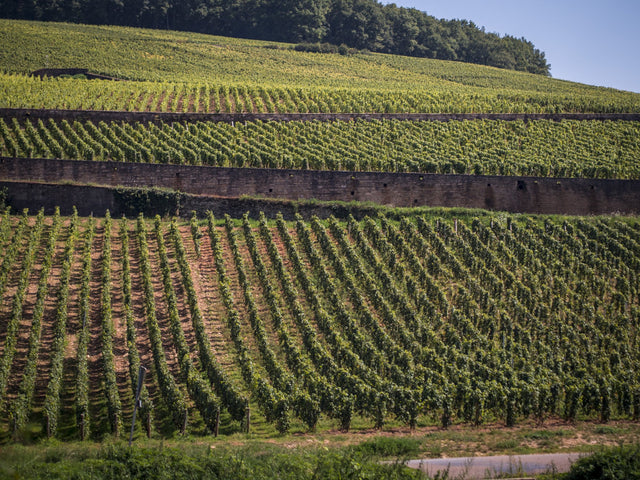
Burgundy, in eastern France, encompasses several subregions, but it is the Côte d'Or that is home to many of the world's most expensive and revered wines. The region, primarily a single east-facing slope, has mixed limestone soils that vary dramatically from village to village and even vineyard to vineyard. White wines, crafted from Chardonnay, range from rich and opulent to lean and intensely mineral, while Pinot Noir produces silky, perfumed red wines of exceptional finesse and complexity. Centuries of winemaking tradition have resulted in every plot being meticulously recognized and scrutinized, making the Côte d'Or a true capital of terroir.
Burgundy - Cote d'Or

Pinot Noir is a thin-skinned, notoriously difficult-to-grow, low-yielding grape that finds its ancestral home in Burgundy, France, where it produces some of the world's most elegant and nuanced wines. While Burgundy remains its spiritual heartland, Pinot Noir has since traveled the globe, finding success in other cooler climates, notably in California, Oregon, New Zealand, and Germany. This grape is a challenge for any grower, as it requires specific conditions to show its best, and yet the wines it produces are capable of such a captivating and singular character.