Skip to content
Welcome to Colorado's best wine shop!

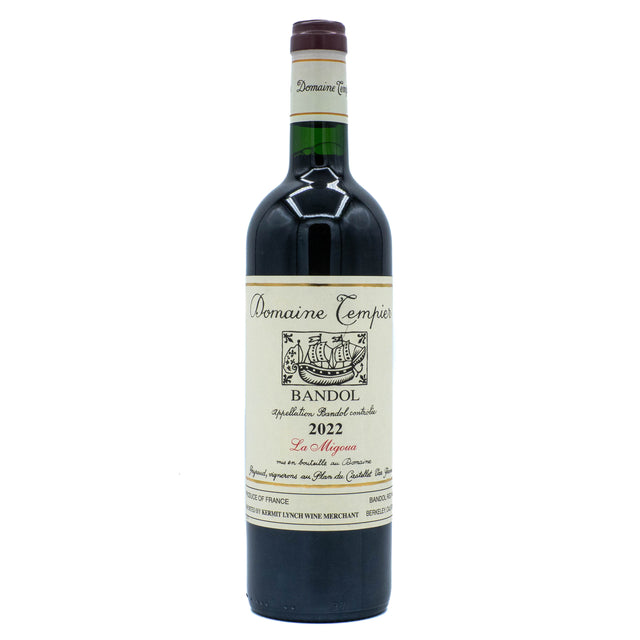
Domaine Tempier Bandol La Migoua 2022

$85.00

We have 1 in stock (Inventory is live and accurate)

The Land

La Migoua grows on ground that is, geologically, upside down. On the Beausset-Vieux massif, a thrust sheet and a later overturn pushed older Triassic clay-limestone up and over younger rock, leaving red, ochre, and blue clays side by side within one vineyard. This is the wildest of Domaine Tempier's three single-vineyard sites: terraced plots ringed by garrigue and pine forest at roughly 270 to 300 meters, among the highest vineyards the domaine farms. The scrubland's wild herbs are the first thing many people find in the glass. Of all the Bandol red wines Tempier makes, this is the one where the hillside speaks loudest.

The Wine

Domaine Tempier Bandol La Migoua 2022 is about half Mourvèdre, with roughly a quarter Cinsault, plus Grenache and a little Syrah, from vines averaging around 40 years. That Cinsault share, far higher than in Tempier's other reds, sets this cuvée apart. Fruit is sorted in the vineyard and again in the cellar, destemmed, crushed, and fermented on native yeasts, then raised 18 to 20 months in 25- to 50-hectoliter oak foudres. Kermit Lynch's team called the 2022 the most wildly perfumed of the trio: summer herbs and bramble on the nose, a soft, juicy middle, and a fresh finish at 14.5 percent alcohol. The 2022 season in Bandol was very dry, with little rain until late June, high summer heat, and the long-awaited rain arriving only in mid-August.

The People

La Migoua exists as its own wine because of two brothers. In the 1960s, Jean-Marie Peyraud, who ran the cellar and sales, and François, who managed the vineyards, began vinifying La Tourtine and La Migoua apart from the rest of the estate, later adding Cabassaou. That decision created Tempier's single-vineyard cuvées. Their parents, Lucien and Lulu Peyraud, had rebuilt the family bastide at Le Plan du Castellet and helped bring Bandol its appellation in 1941. In François's words, La Migoua "fait la boule," filling the mouth before it stretches out on freshness. The brothers retired in 2000 and formed a company with their sisters; the family still meets in council at least five times a year, while Daniel Ravier runs the domaine day to day with organic farming and biodynamic practices.

Food Pairing

La Migoua's herbs and wild edge call for food from the same hillsides. Marinate quail in olive oil, thyme, garlic, and lemon zest, then grill them hard over charcoal; the wine's herbal lift meets the marinade and its acidity cuts the crisp skin. Duck legs braised with green olives, tomato, and orange peel pick up the bramble fruit while the Mourvèdre tannin handles the fat. For something meatless, bake a tian of eggplant, zucchini, and tomato layered with thyme and olive oil, which echoes the garrigue in the glass. Decant it an hour ahead, or lay it down; the domaine gives La Migoua 5 to 20 years, so this bottle can mark a dinner now or one a decade from now.

Select Title

We ship wine to most states with a $100 minimum order for shipping. We don't ship spirits nor beer.

Weather shipping advisory: Orders placed during times of extreme heat or extreme cold will be held for no charge until more favorable weather returns.

0 / 0
The Producer

Domaine Tempier


The Terroir

Tempier is best known for a rosé, but the domaine was replanted to make reds that age. From 1943 the Peyrauds put Mourvèdre, a late-ripening grape that resists oxidation, back into a mosaic of plots around Le Plan du Castellet that now totals about 60 hectares. The soils are all clay-limestone, from Santonian sandstone and marl to Triassic limestone and dolomite, under hard sun, sea air and the mistral.

Each single-vineyard red tracks one site. La Tourtine is 5.5 hectares on a south-facing upper slope below the village of Le Castellet: deep sandstone and marl 85 to 90 million years old, heavy in clay with some gypsum, very windy and very sunny. Cabassaou is 1.5 hectares of terraced restanques just below it, sheltered from the mistral and so hot that its Provençal name means "it hits hard." La Migoua sits at roughly 270 to 300 meters on the Beausset-Vieux massif, where a thrust fault overturned the strata and exposed Triassic clay-limestone. La Laidière, 18 cooler east-facing hectares bought back in 2016, feeds mainly the white and the rosé.

The Tempier family has been on this land since at least 1834, when the bastide was built, but the domaine as it exists today began when Lucie "Lulu" Tempier married Lucien Peyraud and the couple settled here in 1940. Lucien worked with neighbors and the INAO to secure the Bandol appellation in 1941, became head of the growers' syndicate in 1945 and campaigned under the slogan "Plantez du Mourvèdre." Tempier bottled its first rosé in 1943 and its first red Bandol in 1951, under a label drawn by Lulu's father, Alphonse Tempier.

Lulu, born in Marseille in 1917, sold the wines to restaurants across France and cooked for visitors; she died in 2020 at 102. Richard Olney, who co-wrote Lulu's Provençal Table with her in 1994, introduced Kermit Lynch to the family in 1976, and Lynch has imported Tempier ever since. Sons François (vineyards) and Jean-Marie (cellar) ran the estate until 2000. Daniel Ravier now runs it day to day, with grandson Nirvan Rougeot in the cellar and the family meeting as a board at least five times a year.

  • Bandol Rosé About 55% Mourvèdre with Grenache and Cinsault, from 20-year-old vines, part direct press and part skin maceration, raised six to eight months in steel and concrete. The Mourvèdre gives it structure without tannin, which is why the domaine rates it for one to five years and why Jancis Robinson calls it one of the world's few rosés worth aging; the Peyrauds have always poured it beside Lulu's Provençal cooking rather than as an aperitif-only pink, and it belongs on the table year-round.
  • Bandol The classic estate red, now labeled with the tagline Lulu & Lucien for the founding couple: about 75% Mourvèdre with Grenache, Cinsault and a little Carignan, from vines averaging 35 to 40 years across the domaine's terroirs. Fermented 3 to 4 weeks with indigenous yeasts and aged at least 18 months in foudres; the domaine gives it 4 to 15 years, as fruit turns to tobacco, undergrowth and leather.
  • La Migoua About 55% Mourvèdre with roughly 25% Cinsault, 15% Grenache and some Syrah, from 40-year-old vines on the overturned Triassic soils of the Beausset-Vieux massif. Garrigue and pine surround the site, and Kermit Lynch describes the wine as earthy and gamey; the domaine gives it 5 to 20 years.
  • La Tourtine About 85% Mourvèdre with Grenache and Cinsault, from 45- to 50-year-old vines on the clay-rich slope below Le Castellet, aged at least 18 months in foudres. Powerful and tannic, built for 5 to 20 years in bottle.
  • Cabassaou The smallest and densest cuvée: 92 to 94% Mourvèdre with Syrah and a little Cinsault, from vines at least 60 years old on 1.5 hectares of sheltered terraces. The hottest site on the estate gives the ripest, most concentrated wine; the domaine says 10 years or more.
  • Bandol Blanc Mostly Clairette with Ugni Blanc, Bourboulenc and a little Marsanne, drawn from the latest-ripening, coolest plots (La Laidière, La Migoua and Petit Moulin) and aged 8 to 10 months in foudres.

Shop all Domaine Tempier (3)